Episodic Stories – An Anatomy of Visual Novels

Tales From A Distant Land
How
a visual novel is structured is perhaps one of the most important, but
also the least immediately obvious, element for the player. The way in
which the pieces of the narrative fit together often determines the
kind of story you are going to tell and tools available to impart
emotions and ideas. As such the choice to assume a structure based
around Episodic Stories is something worth examining to see exactly
what consequences it has on the games created within it. Over the
course of this analysis the subtleties of this approach to
storytelling for visual novels will be put on full display and also
the opportunities it offers for your own work as well as how these
features might be integrated into it.
 |
| Episodes offer many unique opportunities |
For
this article the idea of Episodic Stories will be tackled from two
angles, single visual novels where the structure of the game is episodic and a series of visual novels where one game is an episode of
a greater narrative. These two are distinct in their implementation but
share a lot of the design features which characterise episodic
storytelling and putting them side by side will reveal what makes
visual novels a prime medium for this style of games.
Internal Episodic Struture
When
it comes to the episodic style within a single visual novel there is
one method which utilises it in its purest form and this is the
Anthology. These games are constructed from a series of mostly self
contained episodes that have an overarching direction while not
influencing each other to any great extent. This method of narrative
presentation allows for the developer to tell a variety of tales with
differing themes and also keep a consistent vision between them
through common elements due to the structure of the visual novel
setting the player’s expectations for the isolated nature of each
one. It might not even have a set point of view character as with
Corpse Party: Book of Shadows which uses the flexible nature of the anthology format to make each of its episodes focus around
different scenarios but it also keeps the core idea of a repeating cycle
present in each one so there is a strong sense that they are all tied
together.
 |
| The anthology is a time tested format for a reason |
Even with a strong through line, this kind of Episodic
Structure can never truly escape the feeling it is just a collection
of pieces rather than a cohesive narrative, since its purity makes its
core elements immediately obvious to the player and they will always
have this at the back of their mind. Some games, such as Ace
Attorney, attempt to mitigate this issue with the inclusion of other
mechanics, like point and click and court room challenges, to provide
stronger connective tissue through another method of player
interaction with the story. However, even these possible aspects can
have the opposite effect by contrasting with, and thus highlighting,
the self contained nature of each episode and drawing unnecessary
attention to it.
On
the opposite extreme are the visual novels which use the episodic
structure but do not openly attempt to present it to the player and
instead blend the beginnings and endings of each story together as
best they can. In this case the episodes are generally consigned to a
longer common route where they act as tool to control the pacing of
this section and the more modular nature of this approach helps hide
any possible clunkiness in the transition into a character route. Visual
novels utilising this structure tend to belong to the Slice of Life
genre with each episode be a different scenario in the characters'
everyday lives and the space provided through it facilitates choices
that reflect only upon the present moment to mitigate the
expectations for consequences. The common route of Cafe Stella is an
excellent example of this practice as it has various self
contained episodes about things which happen at the cafe that are
blended together with a little connective tissue to form the set up
for the character routes and gives each character an episode to shine
in. The issue with this approach is how little it suits genres
outside of Slice of Life, the overall looseness of this type of
episodic structure makes the story feel like it lacks substance and
nothing of importance is happening, which is the opposite of what is
need in a more serious or more plot heavy narrative.
 |
| Episodes are surprisingly good at hiding other strutural elements |
By
its very nature nature episodic storytelling is repetitive, each
episode shares a similar structure with an obvious beginning, middle
and end in order to make the whole experience feel like it is a
complete whole. However, this repetition is not necessarily a
drawback for a certain kind of visual novel which makes particular
use of this feature to build up expectations in order to subvert them
later on. For these games their episodic nature gives them room to
subtly set up a pattern of events to lure the player into a false
sense of security and provide the ideas and themes that will form the
backbone of its subversion. It is a surprisingly flexible framework
as showcased by Sekien no Inganock -What a Beautiful People- which
heavily plays into the repetitive structure for the later twist while
still being able to tell engaging narratives within these restrictions
by clever and emotional writing. This is probably the hardest type of
episodic structure to use since leaning so heavily into repetition
risks boring the player before they even reach the subversion and has
to be handled with care.
External Episodic Struture
In
recent years there has been a trend for releasing shorter visual
novels as part of series of episodes within a greater world and
narrative. The reason for this shift is in part monetary, visual
novels are expensive to make while also mostly having a niche
audience to recoup the cost from and this can lead some developers
into financial problems. Creating smaller, more digestible and more
frequent releases provides a reliable stream of income for the
developer and gives the players regular doses of their favourite
stories to keep them invested in the universe. Perhaps the most
successful example of this model is Grisaia: Phantom Trigger which
has reached its eighth volume and maintains a strong fanbase. It took
the strong basis of the original Grisaia games and made a more
modular version of its core narrative structure (various girls with
issues) with fresh faces to draw in new blood. The result is a
profitable series that keeps its fans satisfied with a constant
trickle of the best aspects of the Grisaia games and keeps the series
alive.
 |
| Higurashi has a lot of episodes at this point |
Of
course money is not the only reason for the existence of episodic
releases for visual novels, it also offers a chance to gain the benefits of
both short and long form writing. Each individual episode is an
inherently short form exercise due to the limited space and as such
allows for a more intimate and character focused story to be told
without becoming lost in the grander narrative. On the flip-side, the
series of episodes in their totality are a long form story that
allows the developer to have more in-depth themes and plots due to
the greater amount of space available to pace them out without losing
the emotion of the individual episodes. Higurashi is a poster child
for this approach to narrative structure with each section having
been released separately and forming their self contained mysteries
which feed into the overarching mystery of the series in an engaging
feedback loop.
In Imitation Of TV Or Inherent To Visual Novels?
When
it comes to episodic storytelling the first thing most people think
of are TV shows since it is incredibility prolific in that medium due
to the need to split the viewing experience into manageable chunks.
It is clear that for many visual novels this is where they got their
ideas about how to adopt the episodic structure into their games. One
of the clearest examples of this is The Sliver Case and its sequel
which lean into detective shows both aesthetically and structurally.
To complement the grimy and noir feeling of the visuals, the games
adopts episodic elements by splitting into story into several
episodes for different characters and has each of them clearly
divided into individual narrative beats with cut-ins as if there is
going to be an advertising break which gives the player a point to
cleanly leave and come back to the game later. This imitation of of
TV undoubtedly has benefits for visual novels leaning into genres
normally covered by it but come across as strange in a medium not
limited by the same issues as it.
 |
| The Sliver Case really does just want to be a TV show |
Many
episodic stories in visual novels are not in imitation of TV and are
instead a variation brought about by the inherent modular nature of their
routes. Visual novels thrive in the telling of different connected
stories and the clear lines between them which often form are perfect
for dividing them into sufficient episodes to increase their
individual focus. Perhaps the strongest game to implement this idea
is Wonderful Everyday with its collection of interconnected episodes
each showcasing a different angle of the same story in a linear order
to control their impact on the player. It takes the character focus
of the standard visual novel routes and breaks it into more
digestible bits where the game can drop hints about the narrative
direction while relying on the structure itself to obscure what is
actually going on until the very end. Any medium who’s standard
structure can be easily broken down into pieces is prime territory
for episodic storytelling and visual novels are no exception to this
rule.
 |
| There a few game structures as memorable as this one |
As
you would expect these two approaches are not mutually exclusive
since both use a similar basis upon which to build their stories.
There are few visual novel which lean into this merger of style due
to it creating confusion in the game’s presentation and this might
prove distracting for a player who would much rather be focusing on
the narrative. However, a few games have succeed in this merger with
one example being 428: Shibuya Scramble. It openly presents its TV
influences through its use of real life photos as its primary visual
identity as well as its episodic presentation of its structure with
each one being treated like part of a TV series. This is blended with
the modular nature of visual novel routes to create a more
interconnected experience and a tighter focus on an intertwining
narrative filled with characters acting out their desires. In
combination these elements create a uniquely charming experience and
a story with a lot of wrinkles to it, but it is also clear that it is
a house of cards which could collapse if either type of structure
becomes too prominent.
Conclusion
There
is something distinctive about the ways in which visual novels have
adapted the episodic storytelling model into their structure. They at
once pay homage to their influences while also playing into the
advantages their own nature gives them with this tool. Not only is
this influence applied to single visual novels but also to entire
series of games which play up the same tricks but over a longer time
frame to keep their series alive and provide the benefits of short
and long term writing. Whether it is to hide the signs where a route
begins, betray expectations or present an anthology of individual
stories, the episodic model is here to stay within visual novels and
presents a compelling case for a the inclusion of even more free-form
styles of structure within the medium. Ultimately its use in a visual
novel comes down to how well the developer can balance its
integration with the other narrative elements they plan on utilising.
The more naturally linear your story is the less it benefits from
being broken up into episodes and instead it will kill the pacing of
the narrative. Despite this complication an episodic structure should
definitely be something you should consider the next time you start
to develop a visual novel.
Developer Spotlight – NomnomNami

Itch.io Website Patreon Cohost
Pastel Colours and Floating Dreams
“Making
stories about cute gays to melt your heart” is a noble ambition and
through their brilliantly bright and heartfelt stories NomnomNami
sets out to fulfil these words. This incredible talent is an indie
developer who operates out of itch.io and has been working for a
number of years now to bring their dream to as many people as
possible. With a pitch perfect mix of light and fluffy presentation
and precise emotional pressure points, NomnomNami has formed an
immediately recognisable style which has attracted deserved attention
from streaming and a dedicated fanbase. Let’s gaze into her
majestic worlds and see what they have to offer and maybe you will
even be convinced to bathe in that pastel vision.
Developer Overview -
Being
able to utilise different game engines and mechanics while maintain
the same style and ideas is the sign of a truly talented developer.
Over the course of her projects she has utlites RPG Maker for several
game, such as the Lonely Wolf Treat series, and Ren’Py to make both
her pure and hybrid visual novels, such as First Kiss at a Spooky
Soiree for the former and Astra's Garden for the latter. There has
been a define push in more recent titles towards the addition of
mechanics lite systems to complement the visual novel’s narrative
and she has publicly released a framework for these elements. Even
the bad ending structure of Bad End Theatre is a manifestation of
this move into exploring new gameplay spaces and as this game’s
success it is a testament to her ability with the engines
she uses.

When
it comes to artwork it is hard to be more memorable then the pastel
colours and sharp contrasts that characterise NomnomNami’s
illustrations. It is challenging to put into words just how much of an
impact on her games the art has for engaging the player with them. In moments bright pink and greens can give way to darker tones
of blue and red while still maintain a consistent core presentation
to ensure it feels like these images all exist within the same
space. In having this ability to switch between strong images the
games gain a wider and stronger set of emotions to invoke in the
player and can do so with greater consistency due to how people
respond to distinctive colours. There is a clear effort to only use
this contrast in key moments to make sure the technique and strength
of the artwork is never diminished through repetition. The fact
each one of NomnomNami’s games has artwork that is so memorable, both individually
and as part of a body of work, is an example of her skill.
Constructing
a consistent tone across all of your games is a difficult task and no
matter how hard you try there will always be some differences, even if
only due to an improvement in your skills. While NomnoNami’s
work is not an exception to this rule, it does have a surprisingly
singular vision for what she wants her work to be. Her statement
about “Making stories about cute gays to melt your heart” is at
the centre of all her work, even if it is not immediately obvious, and
this adds a certain set of expectation to each new game which she
often uses as a means to subvert or push the emotional themes of the
work. Even when there is no hidden agenda, it provides her games with
a sense of fluffy familiarity to ensure the player is comfortable in
the experience and leaves with a smile on their face.
Selection of Notable Works-
Bad End Theatre

If
you have ever heard of NomnomNami then it is likely because of this
game and the attention drawn to it by content creators such as
Markiplier. This visual novel really is the perfect storm of
everything which makes NomnomNami’s work so special with keen
character writing, striking visuals and emotive moments. Its title
makes the core focus of the narrative immediately clear but does not
truly express just how clever this play on the structure of the bad
end is from the player’s perspective. Through presenting the
structure of the visual novel itself as the puzzle the player must
overcome, they are given a feelings of both agency and powerlessness,
often at the same time, that helps sell the situation of the
characters alongside the overall themes. The various bad things which
happen to the characters are prevented from becoming to bleak due to
a deliberate effort to inject levity into every crevice it can be and
coupled with a distinctive use of colour and art style it creates a
balanced package. However, this is not to say this game pulls all its
punches, when it needs to it will provide the appropriate twist of
the knife to hit your emotions. Bad End Theatre is an example of a
game which deserves the attention it received and captures what makes
its developer shine in its purest form.
HER TEARS WERE MY LIGHT

This
is one of NomnomNami’s
earlier
games having been released for NaNoRenO
2016, but even after all this time it still remains one of her
strongest short and self-contained visual novels with it even
receiving a content update last year. Contrast
is both the narrative and visual core of Her Tear Were My Light, from
the darkness of space with the light of the stars to warmth of
companionship with the cold of isolation, it is in every moment.
Their is an excellent understanding of how to use this technique
to squeeze the most into the short play time as possible and make each second sell
the emotions which are the game’s primary method of engagement. As
with many short visual novels, Her Tears Were My Light focuses around
creating emotional resonance rather than any expansive ideas due to
the issues inherent in this constricted narrative form and it
achieves this effect through its small cast. There are three
characters in total and each of them have an exact purpose within the
narrative which they adhere to in order that there be no wasted space
and this results in a clean experience where the player gets a strong
sense of what defines them. In combination, all of these factors
create a compelling and easily digestible visual novel that acts as a
sweet gateway into her other work.
Syrup and the Ultimate Sweet

Very
few games offer you multiple opportunities to eat a main heroine and
for that heroine to actively court the idea. This is the strange and
quirky tone which is soaked into every fibre of the narrative and
presentation from its cheerful characters to its bright artwork and
these allow it to excel in creating a memorable impression on the
player. The pastel colours and confectionery themed cast names act to
reinforce the ‘sweet’ nature of the bonds that we witness form
and reshape as the nature of the mysterious Gumdrop is revealed. A
sense of playfulness extends to the choices with the most noticeable
being the option to eat Gumdrop and the way it is obviously
telegraphed as the incorrect choice, but at the same time there is a
sense of the game actively daring you to choose the bad one. What
results is a tongue and cheek story with an ability to build a
feeling of goodwill between the game and the player for the purpose
of creating an entertaining ride.
Conclusion
Forming
a signature style is key to the success of many developers and
NomnomNami is a shining example of what doing so can contribute to the
quality and appeal of your work. Her games have an impressively wide
appeal but still retain the ability to pack an emotional punch with a
clear and focused vision for what each title aims to accomplish. If
anything in this overview has sparked your interest then I strongly
encourage you to give one of her games a chance and find out for
yourself the intensity of her emotional stories.
Kiss the Demiurge Review – Flowers in a Garden of Demons

Genre – Yuri, Modern Fantasy Play Time – 6 hours Developer – YuriEureka Steam VNDB
Note
– I did receive a review copy from the developer. A heads up if
that fact might bother you.
Something Wicked This Way Comes
In
most settling magic is normally a force for good and even when it is
not, the protagonist is special enough to make the most of it
regardless. This is not the case for Minori, magic took away what she
held dear and ignited in her a zealous hatred of magic which has
consumed her life. Such is the set up for Kiss the Demiurge the first
game from YuriEureka, a Yuri
centric visual novel developer, and it leaves a strong first
impression with this aggressively negative presentation of magic. If
there was a game which exemplified the idea of betting everything on the
story then this game is surely the poster child with an initial
visual presentation which might turn some people off. But does this
whole hearted commitment to the narrative pay off? Let’s launch an
infiltration of the Magic Club and find out.
In Pursuit of Magic – Themes and Narrative
Magic
is at the heart of Kiss the Demiurge, both as a narrative and
thematic element. It binds each character in the Magic Club to their
past and not always in the way you first expect. They cannot live
without it but it is a curse upon them that prevents them from accepting
who they are here and now. It combines these strong thematics with a
variety of character routes that reflected uniquely back onto Minori
in clever ways. However, its narrative is not without issues which
stem from its opening act.
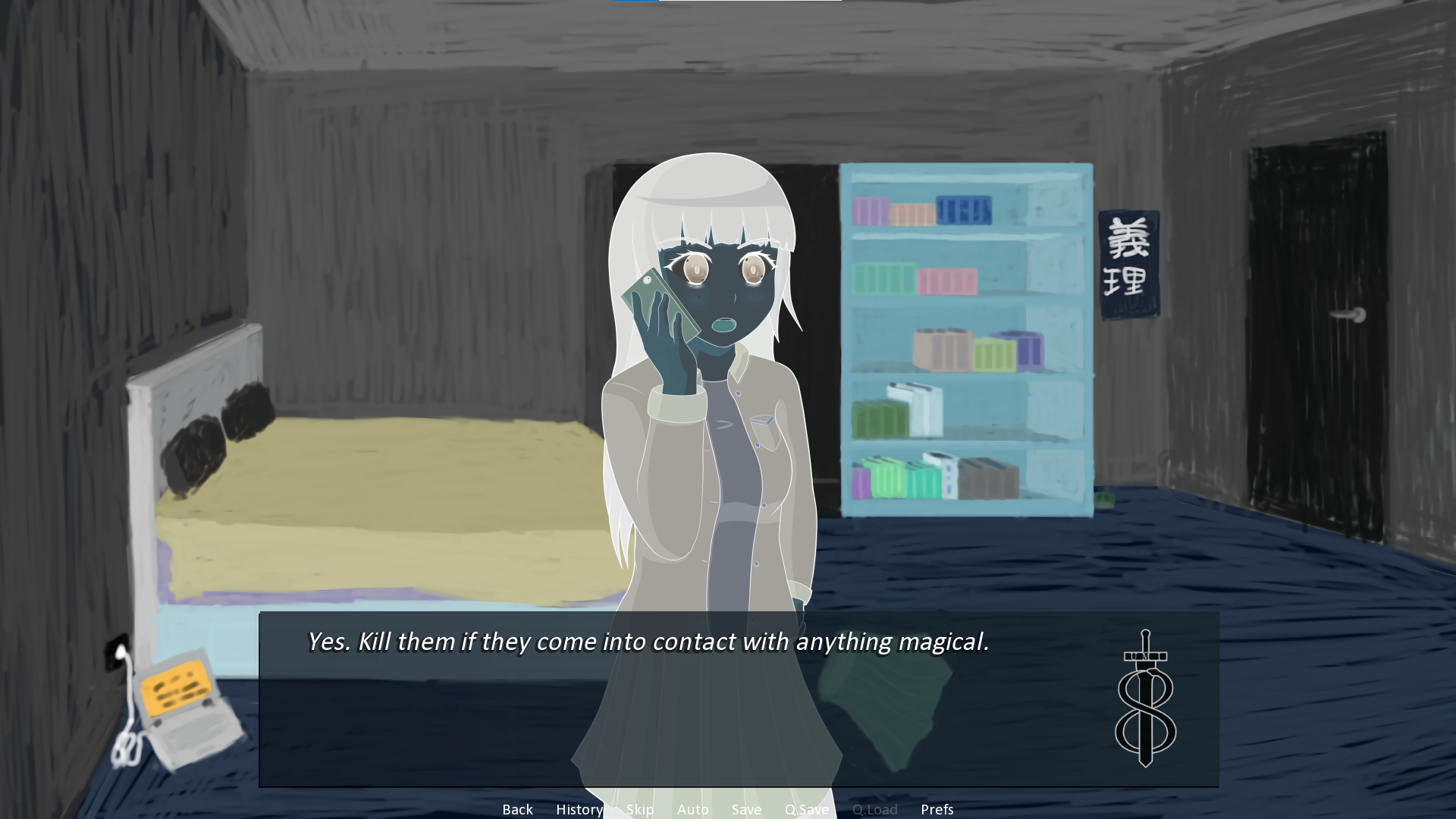 |
| Magic defines these characters |
The
single strongest element of Kiss the Demiurge is how it handles its
character routes. All three routes are focused around the
Minori’s core conflict related to her missing parents and each one
of them approaches the issue from its own unique and heroine centric
angle. There is a superb balance between the time given to Minori and
the route’s heroine with the two intertwining to such a degree that
a scene related to one often pulls double duty as an examination of
the other’s motivations. Alongside the greater conflict are the
smaller interpersonal conflicts between the pair and they act to both
accentuate the bigger events and as a moment for the player to catch their breath
before the next gut punch.
They are also not entirely divorced
from the overarching conflict since the tension between the
characters has not gone away and these smaller events sell its
continued presence in their minds. At the same time they are light
enough by comparison to provide a second of peace and levity to
affairs so the story does not become too dire and risk the player
losing empathy with these characters, and giving them a bit more
humanity by mixing in some smaller parts of their lives. It also works
as an excellent pacing mechanism through these points of low stakes which it
uses to contrast the more important moments and contributes to the
amazingly paced roller coaster of emotion each character route
captures.
 |
| It is hard to agree with Minori's assessment of the Magic Club |
Binding
every part of Kiss the Demiurge together is the spectre of magic. It
haunts all the characters both directly, with the members of the
Magic Club, or indirectly, with the cast’s families, either way it
circles back to the emotional core of each character. For these
characters magic is an escape from something they don’t want to
face and it provides a convenient excuse to pretend that they have
some power over a situation they in reality do not. It is used by
the narrative as a meaning of concisely conveying the themes of
accepting the past and loving yourself through offering a negative
example of them and asking the characters to overcome it. While what
each character is attempting to obscure from themselves is different, they are all able to act as mirrors for Minori due
to their common investment in magic and it helps sell the idea that no
one is above the feelings these characters are struggling with. The
deftness on display with how the narrative handles this thematic
keystone is a sight to behold and works wonders to elevate the story
to greater heights.
 |
| Selling the emotion of key scenes is one of this game's strengths |
If
there is one notable weakness to the story, it is in the short and
rushed feeling common route. This is a problem since this
part of the game contains most of the narrative set up for the three
routes as well as most of the interactions designed to sell the group
dynamic. While the basic premise of Kiss the Demiurge is not a
complicated one, the lack of room given to presenting it to the
player leaves it feeling underdeveloped and the transition into the
character routes abrupt. In choosing to rush into the main routes, the
game lacks the establishing pacing generally offered by a common
route and does not properly account for any possible confusion it
could cause. Adding to this lacking feeling is the surprising absence
of many scene which sell the Magic Club as a group rather than just
their relationships with Minori. This results is a strange disconnect
between their supposed friendship as they tell it and what the player
actually witnesses and once the character routes start it leads to a
feeling that the heroines exist in their own narrative bubble rather
than as a group. Neither of these issues are deal breaking and their
brevity also acts to hide their flaws as the player will quickly move
onto the meat of the game and forget all about them.
Magic Club Misfits – Characters
No
matter how good a story's structure and themes are they are nothing
without a set of character to make the player care. Fortunately the cast
of Kiss the Demiurge fill this role with flying colours and form
compelling bonds with Minori which both complement and contrast her
personality and desires. This extends down to the secondary cast
albeit to the weaker extent you would expect of more minor
characters.
It
is rare to have a zealot as the protagonist, someone so fixated on a
single cause that they cannot see the absurdity of their words and
actions. Minori so completely believes in her crusade against the
evils of magic to the point at which she does not understand the
damage she is doing to others and herself. At the same time this also
gives us a peak into just how fragile she is with this purpose being
the only thing holding her together. Her beliefs are so absolute yet
so full of holes that the result is a picture of a uniquely human
individual who has become lost from any source of happiness. It is in
how she interacts with the members of the magic club where we can see
the strength of choosing this kind of protagonist. There is a
constant battle inside Minori between her hatred of magic and her
burgeoning feelings for each heroine, between the curse of the past
and the promise of the future, and as this conflict slowly tears her
apart we get to see the truth of her motivations. This all makes from
a strong protagonist to act as our eyes into this world and someone who is at
once alien and familiar to the player.
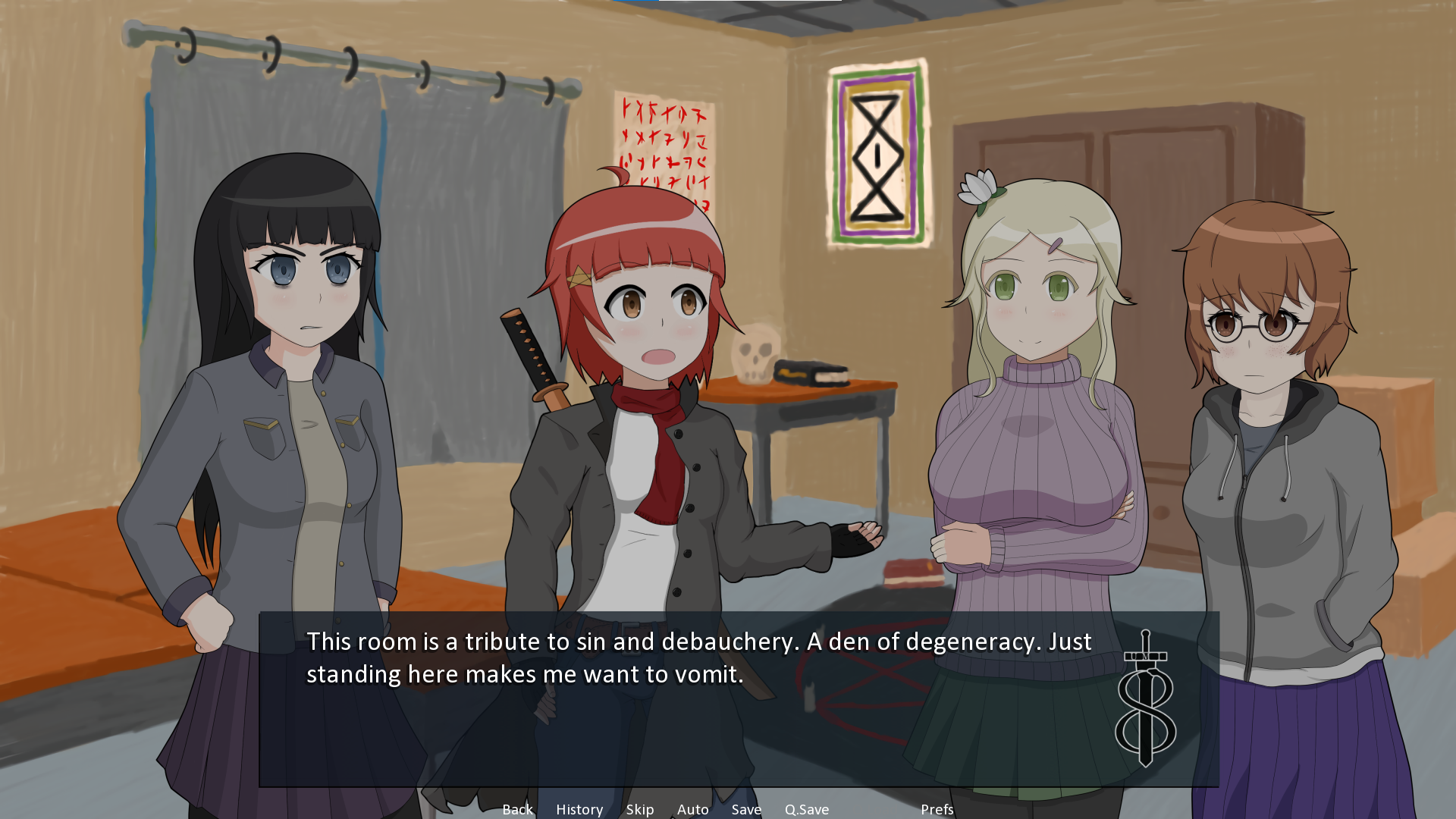 |
| Minori has some strange ideas of sin |
When
it comes to Minori’s love interests, the three members of the Magic
Club, they prove to be just as strong characters as she is with each
of them offering a different kind of contrast to her. We have the
high energy Akane, the timid Chitori and the elegant Tomoko, they are
all things Minori is not and this works to define them against one
another while at the same time showcasing their personalities. Each
heroine reflects something back onto Minori, it starts out as just
personality flaws and ends up being their greater trauma. Minori is
forced to face the parts of her she does not want to see through
them just as they do through her. Their competing personalities lead
to distinctly different feeling character dynamics such as Minori being
the more assertive member in the relationship with Akane but the
weaker and more dependent person with Tomoko. Their bonds are define
their interactions and the events with excellently written banter to
help sell the lows and highs in their lives.
 |
| Can you tell this is a Yuri vn? |
Nobody
is left out of good characterisation in Kiss the Demiurge and this is
especially true for the secondary characters. Despite their
relatively short screen time each one has an important impact on
Minori and the heroines' lives with them being given key information
or character development for the main cast. They are also wonderfully
distributed by having only one or two be the focus for a route and
this gives each one the space they need to shine while so preventing
the narrative from being cluttered with unnecessary characters. It is
this ability to balance the presence of characters which might be the
single most astonishing part of this visual novel and allows it to
weave in and out of interesting events with ease.
Achieving a Lot with a Little – Visual, Audio and Technical
These
three areas are the points at which Kiss the Demiurge shows its
biggest weaknesses and the constraints of the budget under which it
was made. While it does still have some great elements in these
areas, it is obvious that the game is not attempting to sell itself
on visual or audio presentation and if you are going to play this
visual novel it is going to be in spite of them and not because of
them.
The
quality of the art Kiss the Demiurge uses from its character
portraits and backgrounds is easily its weakest aspect. The character
portraits are awkward in their posing and lack overall detail giving
them a slight feeling of being uncanny. There is also a lack of
different expression in general, with secondary characters like
Minori’s mother suffering from only having one expression making
her appear miserable at all times even when she is supposed to be
happy. If there is one benefit to the style of these portraits it is
the choice to have none important characters be presented as indistinct
black human shapes and how it helps communicate Minori’s state of
mind with her fixation on a few people and her lack of care about
anyone else. Backgrounds suffer from a similar lack of detail to the
portraits but since they are not the focus of most scenes this
impacts the player’s enjoyment to a lesser extant. Despite this
issue they are effectively used by having backgrounds alter depending
on the character action in a scene and provides the sense that the
backgrounds and character are part of the same world rather than
disconnected elements.
 |
| Black shapes represent unimportant people and really sell Minori's mindset |
CGs
are the one area where the quality of the artwork is noticeably
higher and each one is an impressive in its beautiful use of colour
and motion. While they are few in number over the course of the game,
their infrequency adds to the impact they have when one appears on
screen and allows the moments they accompany to stand out from the
rest of the narrative. The choice of music is generally used to a
similar effect but there is a noticeable lack of variety to it, so
expect to hear the same tracks quite often. They are all suitable for
the game’s tone and narrative and fulfil their function setting the
mood and contributing to selling the emotions and events.
 |
| This is definetly the Ren'py I remember... |
Kiss
the Demiurge was made using the Ren’Py engine and this fact is
immediately obvious since little effort has been make to change the
basic appearance and functionality of its interface. Some menu assets
have been custom made, most notably the main menu and the text box,
and these do give the game a distinct feel when present, but
everywhere else the clunky and blocky Ren’Py assets are obvious.
This results in an amateurish feeling product when the player initially
boots it up and whenever the go to save or change the game settings. On
the more practical side, the game inherits all of the accessibility
problems from the lack of broad customisation and strange quirks of
the engine which a more polished product would have ironed out
through extensive improvements to the core design. None of this is a
deal breaker for most people who will play the game, but for those
who it might inconvenience it is something to consider.
Verdict -
A cast of compelling characters and haunting themes define Kiss the Demiurge and come together to form memorable package which overcomes its flaws.
Pros
+Minori
is a compelling protagonist filled with zealous fervour yet slowly
falling apart at the seams and seeing how she reacts to the rest of
the cast is always engaging.
+A
strong casts whose moments of weakness and strength humanise them
while simultaneous link them in a common idea of escapism from one’s
own weakness.
+The
heroines’ character arcs are perfectly woven into Minori’s own in
a way which brings out a different side of her for each of them.
Cons
-The
majority of the art is of middling quality with a lack of variety in
character expressions which can lead to the game feeling stilted.
-Early
pacing is a bit off leaving the common route feeling rushed in favour
of individual character routes and the group dynamic in a lacking
state.
-Interface
is a slightly alter version of the base Ren’py one and has all its
quirks and irritations.
Best Visual Novel Releases – January 2023

A
new year has begun and in this month of new beginnings we all start
out into an unknown future and visual novels are no different. It
has been a quiet march across the start line for major releases with
this month seeing none of note. However, it is exactly in this down
time where the indie scene and fan translations can come to the front
and make themselves felt. We have engaging Yuri and Otome, a visual
novel and action rpg hybrid and an innovative game presented entirely
through letters. Let’s look at what the first month has brought us.
Official Releases
Miracle Snack Shop -

Fancy
something sweet? Well this visual novel has you covered in both senses
of the word with the strange tale of a Korean snack shop. Rather than
being a pure visual novel this is a hybrid with a management sim
where the day to day running of the snack shop is simulated to immerse
the player in the narrative. It also has a sizeable fantasy element
in the form of a main heroine, Philia Salis, who appears from a
portal and is queen of an icy land, and this should give you an idea
of the overall tone of the game and, while there are a few twists, it
mostly sticks to it throughout the entire play time. It is not
everyday we get an interesting Korean visual novel like this translated into
English and it is a refreshing insight into a culinary
culture different from what is normal for Japanese or English
language releases. If you are looking for something short and a bit
different then Miracle Snack Shop is for you.
A Maiden Astrologer Divines the Future -

Various
kinds of divination are often used as throw away tropes and are
rarely given the spotlight as the central narrative device. A Maiden
Astrologer Divines The Future aims to buck this trend with a
heart-warming Yuri story which makes full use of divination as its
core thematic element. The story follows Mizushiro Isumi as she
divines the future for her clients in a small coffee shop, but strange
things start happening around her and as she starts to investigate
she meets a girl named Maki and her life will soon be reshaped by
their bond. Since this is a short game the emphasis is placed on the
main relationship and its dynamic to hold the entire experience up
and for the most part it succeeds with a pairing which showcase how
to play contrasting personalities off one another. Overall it is an
excellent bite sized and comfortable romance story with a distinctive
spin on the formula.
Hoping This Finds You Well -

Finding
the right words to communicate your feelings is hard and
it is easy to get sidetracked with unimportant details. This is what
Hoping This Finds You Well captures through its choice to present its
narrative as a series of letters written backwards and forwards
between two people. The result is a tale which show both the
intimacy and distance present in a relationship and how people can
talk passed each other even when they mean well. A relationship is an
awkward and messy thing were both participants are never completely
sure what the other is thinking and this is something the game
manages to express with surprising emotion. It is an extremely short
visual novel but has some of the most unique presentation in recent
memory and a concisely told story that does exactly what is sets out
to do.
Tristia: Restore -

Having
a genius protagonist risks alienating the player when the character
achieve their goals with little effort and cheats the narrative out
of the catharsis of overcoming the odds. The answer which Tristia:
Restore reached was to lean into a light hearted tone and play up the
endearing characteristics of its protagonist to make her victories
still hold meaning as you want to see her succeed in her good natured
deeds. Thus in Nanoca Flanca we have a protagonist who makes for a
most entertaining point of view character for this action/visual
novel hybrid game. This is a game that lets you know immediately it
does not want to be taken seriously. From the moment you start the
game the colours and dialogue sell the low stakes and relaxing vibe it proceeds to immerse you into. Something for those who want a
light and simple story with action gameplay to keep them engaged.
Fan Translations
Brothers Conflict: Precious Baby -
Patch Download VNDB Genre
– Otome, Romance Play Time – 60 hours

The
dream of being surrounded by hot guys is very much alive in Brothers
Conflict: Precious Baby and it knows exactly what its Otome loving
audience wants to see. This is a game which is very open with its
romantic fantasy to the point of being slightly absurd and, while it
might turn off some people, those it resonates with will find a
visual novel that knows how to play to the strengths of the genre.
When Asahina Ema’s mother remarries Ema suddenly gains eleven new
brothers and the player gains a wide selection of romance options all
with the spice of forbidden love. Given how spread thin the play time
is between each hero, there is an astonishing level of character
definition achieved for all of them and this goes a long way in
selling them as legitimately compatible with Ema. While this is not a
visual novel for everyone, but it knows its audience and for them
this is a gem worth their time.
Meaningless Choices – An Anatomy of Visual Novels

Empty and Pointless?
The
illusion of choice is one of a video game’s most fragile tools, a
single contradiction or misstep in presentation and the whole thing
shatters and the player feels cheated. As such the idea of a
Meaningless Choice is one which is viewed in a negative light as
something to avoid alongside the idea that all choices must offer
some form of consequence, no matter how minor. Games such a Mass
Effect and output of Telltale embody this fear of making anything the
player does feel as if it does not matter. A Meaningless Choice is
one which does not effect the outcome of the game in any noticeable
fashion outside of a possible change in one or two lines of dialogue after the choice, or could even be the same choice offered
multiple times, and it is the boogeyman of narrative choice focused
games.
 |
| This is perhaps the most icon Meaningless Choice and for good reason |
When
it comes to visual novels the picture becomes noticeably blurrier, on
the one hand there are those which follow the common wisdom and make
the choices all have meaning, such as increasing the affection value
with a heroine, but on the other are those which use a large amount
of Meaningless Choices in their structure, often mixed in with real
ones. It is this second group which will be the focus of this
analysis and the surprising ways that the unique position of visual
novels allows them to be more flexible with the presentation of
choice.
Engagement For The Player
At
their most basic level all choices serve the purpose of engaging the
player, be it through the consideration of romantic options or life
or death battles. Meaningless Choices also fall under this category,
but due to their inherent low value they act upon the player in their
own distinct manner. Rather than providing any grand spectacle, their
role is to keep the dial of engagement ticking up and prevent the
player from losing interest by showering them with smaller doses of
the highs given by more significant decisions. These small nods to
the player involve them more directly in the narrative and give them
a moment to pause and ponder what has just occurred, which engages them with story
in a more conscious manner while they make their decision. It is easy
for the player to slip into a trance like state and not be properly
looking at what is being presented to them and, given the narrative
heavy nature of visual novels, could lead to a sense of boredom due to
the lack of other gameplay elements to keep their attention. By containing small points of engagement, visual novels can
avoid this pitfall and also create a cohesion throughout the entire
experience, hence the use of Meaningless Choices. Aokana -Four
Rhythms Across the Blue- uses this approach to pad out the space
between its important choices but uses them sparingly enough to make
sure they are still effective and unobtrusive. There is a careful
balance showcased in Aokana between having Meaningless Choices to
increase engagement and just using them to fill space which could
cause the player to become irritated with the constant interruptions, and this is key to their presence in a visual novel being beneficial.
 |
| Can you determine a Meanless Choice from a real one? |
Choices As Roleplay
By
far the most common use of Meaningless Choices is as a means for the
player to roleplay as the protagonist. This generally
takes the form of deciding their reaction to events which are
obviously of no importance and provide a selection of in character
choices to give the player a little room to co-author the
character. Having a co-authored protagonist is far from unique to
visual novels as many western rpgs use similar techniques for their
player character with perhaps the most iconic of these being Geralt from the
Witcher games. However, it is far more prolific in the medium of
visual novels, pick up any of them and you will likely find each one
has some degree of Roleplay Choices. This prolific presence is no
doubt due to the increased importance choices have in visual novels
as the primary means of interacting with the player, outside of
including some other gameplay style, and
means that visual novels must make the most out of this limited
resource. OELVNs in
particular tend to use Roleplay Choices due to their closer cultural
relationship to western rpgs with games like Sunrider leaning heavily
into this aspect of visual novels to supplement the narrative feel of
their events.
 |
| Sunrider is a game which leans heavily into the Mass Effect school of choice design |
The
advantages of Roleplay choices are twofold, on the one hand it
disguise the fact that these choice have no consequences by
presenting enough personality in the choices that the player cannot
be sure if the choice has any greater meaning, while at the same time still
knowing they are of only minor consequence. A camouflage like this
helps the visual novel maintain a sense that its choices have gravity,
with some having more significance than others, and prevents their
sense of agency from being compromised. On the other hand it allows
the player to form an attachment to protagonist through their role in
shaping the character in their everyday life and as a result
they feeling invested in the outcomes of the narrative when things
get tough. Since visual novels are often focused around a single
point of view character, it is all the more important that the player
feel investment in that character as without them the player may loose
interest the longer the game goes on and Roleplay Choices offer a
clean and easy to implement means of preventing this issue.
Immersion In A Feeling Of Helplessness
Sometimes
the sense of agency provided from choices can be turned on its head,
the player can be stripped of power through Meaningless Choices and be
made to feel the powerlessness of the characters. Most other games
would fear the idea of putting the player in a position of weakness
like this since many lean heavily into a power fantasy and would be
concerned about the player losing interest if this illusion is not
constantly fed. Visual novels by comparison tend towards a variety of
forms of emotional resonance and often choose to have lows to
complement the highs which other games would struggle to implement.
 |
| Atmosphere is what Cartagra values above all else |
Stripping
the player of their primary agency while still offering the pretence
of choice is what Meaningless Choices excel at. They make it clear to
the player how helpless the protagonist is and how
nothing they attempt changes an outcome they never had any control
over. Rather than simply being told this is the case, the player gets
to experience the character's feelings through their own actions in
the face of this unchanging reality. Cartagra: Affliction of the Soul
is a strong example of how effective this technique can be for
creating empathy. While it does have some real choices mixed in, it
uses a heavy amount of Meaningless Choices to communicate to the
player the desperation and powerlessness of its protagonist in the
face of the murders which threaten those he holds dear. It
compliments the overall bleak tone of the game and allows the player
to sink into the atmosphere and character mindsets without the game
having to spell it out from them. Of course this approach is a
balancing act, be too aggressive with the choices and the tone can
become overbearing or silly in the absurdity of the lack of
consequences, but be too light in their use and the player may not
even notice the intended effect at all.
Disguising What Choices Actually Matter
As
alluded to earlier, the function that ties together the use of the
Meaningless Choice is its ability to disguise what choices have
consequences and what is just filler. This not only functions as a
form of engagement by keeping the player on their toes, but more
importantly it also serves to create a more believable experience.
Our lives are not only determined by single large choices but also
the smaller choices of our everyday activities can collectively have
just as much of an impact. As we grow up we learn the intricacies of
these choices to the point at which they almost become second nature
and are only thought about at the back of our minds. It is this lower
level decision making which Meaningless Choices simulates and so the
player inherently ascribes value to them where none exist since it
resembles something they are intimately familiar with. In doing so
Meaningless Choices hide the important choices in a coat of noise
while helping them to appear more natural in an apparent web of
choice and consequence. Most visual novels using Meaningless Choices
utilise this technique in some fashion, even if it is only by
accident, it is a fairly common feature in the Slice of Life genre such in
the Sakura games and My Girlfriend is the President who use it to
create a sense of normality to their worlds.
 |
| The Sakura games have some of the most vanilla choice design in the medium |
Conclusion
Every
part of a visual novel serves some function even if it was not
intended by the developer, and Meaningless Choices are a strong
example of how careful consideration of every aspect is needed to
avoid any undesired influences on the player. They can form a solid
backbone for the more substantial narrative elements by providing the
space to roleplay and disguise the choices which actually matter
while helping hold the player’s engagement. On the other hand they
can offer a chance to disempower the player through a feeling of
helplessness in the face of what appear to be unavoidable fates.
There is an impressive degree of flexibility to Meaningless Choices and they are
a strong tool in your development toolbox and are more than filler,
just beware of overusing them as the illusion could quickly breakdown.


 Posts
Posts

