Showing posts with label Ototme. Show all posts
Otome – Genre Deep Dive

A Feminine Touch
As
the inversion of the male centric structures typical of many visual
novels, it may be tempting to dismiss the beautiful woman surrounded
by handsome men as being more of the same just with the roles
swapped. However, this change in gender focus results in a
fundamental shift in design philosophy in order to appeal to a
noticeable different demographic. The larger male cast in the form of
the suitors is reflected in the way they clash and interact with each
other and their more aggressive pursuit of the heroine’s
affections. Emotional intelligence defines the Otome heroine, they
mix personal vulnerability with strength in their romance and
complete the suitor in a way which places the pair on equal footing.
Otome’s freedom from the typical trappings of the male centric
romances allow for a broader spread of settings, themes and tones
without losing sight of the attractions of the romance fantasy. Yet
it still adheres to much of the overarching expectations of visual
novels such as choices, routes and even its use of erotic content.
Let’s flee from the parade of adoring men and find out how the
genre’s core features promote such a distinct identity.
Pursued By Suitors
Just
like the heroines of male centric visual novels, the suitors are the
main selling points of Otome and form the backbone of the conflicts
and narrative direction. They differentiate themselves from their
female equivalents through how their masculinity is played up to achieve
a unique suite of personalities. Suitors tend to be more aggressive
and possessive in their romantic pursuit of the heroine and they are
often the ones to initiate the first push even if the heroine ends up
being the person who makes their relationship a reality. Amnesia: Memories
loves its its overly possessive men with almost all of the suitors
demonstrating these tenancies at some point or another. By far the
most extreme example of this is Touma who locks the protagonist up in
a cage in what he claims is an act for her own safety and, while the
game does treat it an overprotective action, it is never painted as
negative. Instead he is just letting the possessive aspect of his
love taking over and the protagonist has to work to bring him back to
reality so they can be together. This allows the
protagonist an agency over the narrative through being the one
who ultimately resolves the conflict with a taming of the beast
style of romantic fantasy.
 |
| Not exactly a great first impression |
Undertones of violence are a common among
Otome suitors were the man is just a powder keg waiting for a spark
to ignite. Mixing in this trait gives a sense of danger to what might
otherwise be fairly vanilla romances and expanding on how conflict
can be handled within the narrative. The suitors of BUSTAFELLOWS are
all have a certain degree of this undertone due to their connections
to the criminal underworld. On a moment to moment level this works as
a way to keep the player on their toes since the treats facing the
heroine could be inside the group and well as external to it. Even
when it becomes clear the suitors are not an immediate danger the
tension still remains for the men with more direct connections to
violence such as Shu Lyn O'Keefe. The narrative value then
transforms into a process of overcoming the barrier this presents
between heroine and suitor and fleshing out their character arcs as
the motives of the suitor are revealed. It is worth noting at this
point the connection between these traits, attractiveness and erotic
appeal within the genre’s audience. While Otome eroge rarely get
localised they do in fact exist and display the same aspects of
masculinity just filtered through the characters’ sexuality. Let’s
look at one of the few translated examples in Fashioning Little Miss
Lonesome. It is different in tone from the previous titles covered as
a comedy romance and so lacks the direct undertones of violence
present it those games. Yet when it comes to possessiveness and
aggressiveness the suitors are more than happy to oblige as they
pursue the heroine and coerce her into going along with their plans.
This plays into the comedy and erotic nature of the game through its
sheer absurdity and the way it leans into these as attractive
elements to create an appealing and safe fantasy for the player to
enjoy.
The Not So Distress Damsel
Otome
heroines make for an interesting contrast when compared to their male
equivalents given how vulnerability has a prominent role in their
characterisation and development. This is not the same as being weak
where they are a damsel in distress to be protected by the suitor,
even if that style of narrative does exist within Otome. Rather it is
a characteristic of their emotional intelligence where they are able to be open with their own feelings in a way male character is simply
not able to be. This is especially important in the way it relates to
the suitors since they need her to help them sort out their own
chaotic emotions and reach the happiness they desire. Through this
the heroine attains a critical non violent role within the story’s
progression to ensure they are always relevant and pushing the plot
forwards. The heroine of Hakuouki, Yukimura Chizuru, is a good
example of this idea as while she does have some martial skill and
supernatural blood in her veins, her identity in relation to the
suitors in not defined by these traits for they instead come to rely on her
to be their emotional crutch. As the suitors place in the world is
taken away from them over the course of the narrative, Yukimura
remains the only constant in their lives and she has to grapple with
their increasingly decaying mental state in an effort to save them
from this downward spiral. Her ability to successfully navigate this
process works well as a core pillar of the game since its heightened
feelings naturally lead to big outburst and powerfully empathetic
moments from both sides of the relationship.
 |
| A promise can mean a lot |
A variation of this can
be seen with Steam Prison’s heroine, Cyrus Tistella, who early on
in the story is placed into a dangerous situation which she spends the
rest of the game dealing with and manages to do so in no small part
due to her emotional intelligence. It is through her ability to see beyond the fronts of the suitors she is able to pull herself up after her
fall from grace since she is able to pull out the good in them even
when it appears there might not be any. What is important here is the
way this sensitivity to emotion serves her better than her notable
physical prowess, in part due to her diminished position, but mainly
due to the way it aligns the game’s themes unity and seeing beyond
discrimination. Another approach to this emotional sensitivity is
contrasting it with the violence which the heroine and those around them
engage in. Ueno Enju from Nightshade presents this conflict between
the two sides of the heroine, the emotions she feels for those around
her and the shinobi heritage which she takes pride in yet is a path steeped in violence and ruin. The outcome of the story is based on which side
she chooses and so is how the suitors react to her which makes for an
engaging friction amongst the group.
Conflict Across The Spectrum
One
of the noticeable features of Otome is a willingness to leave the
confines of the typical school setting and try its hand at stories
in a fantastical or adult environment. Schools do still have a major
presence in the genre but not quite the strangle hold it has over
male orientated titles. The kinds of female appealing narratives offer
a greater degree of freedom in the way they can be presented to the
player as demonstrated in the previous sections. Underpinning this
flexibility is the aforementioned elements of danger from the suitors
masculinity which naturally lends itself to being mixed in with other
sources of more mature threats and mysteries. Many of these settings
have the characters as adults within a working environment like the
police in Collar x Malice. For its protagonist, Hoshino Ichika, her
work provides a reason for her to become involved with the suitors
and place herself in danger while doubling up as an avenue to express
the game’s themes. Given the already contrived nature of the
title’s set up, it would have had to tie itself in even more knots
to get a school setting to make sense on top of it not meshing with
the tone it wants to establish. The work environment and professional
experience of the cast also lend the narrative a baseline level of
maturity within the player’s mind before they even open their mouths
and further reinforce this direction. Otomes entirely detached from
the real world are also freed from the school mandate if they set the
appropriate expectations, such as with Psychedelica of the Ashen
Hawk. Under a blanket of thick snow and medieval trappings the game
keeps any thoughts of school out of the player’s head by rapidly
defining the limits of its narrative space and confining them within
its walls. Despite the relatively young age of the protagonist, the
focus on the concealing their gender and the danger they become
involved in make sure the forwards pressure becomes a core aspect of
the title’s identity. Such a story relies on the completeness and
alien nature of its setting to immerse the player and so the freedom
from setting expectations allows it commit to the absence of familiar
elements from our own world.
 |
| Colours and place create a powerful sense of place |
Conclusion
No
genre is quite the same as Otome with its particular vision of
romance, drama and characters, even its male equivalents tend towards
stories of very different kinds. Part of this uniqueness stems from
the suitors and the way they lean into their possessive and pursuit
of the heroine to create a cast of proactive and dynamic individuals.
It is also a genre not bound to the school setting to the same level
as its peers so offers a flexible package for a greater variety of
stories to be told within it. The way the heroines of Otome get to
present their strength and vulnerability through their emotional
intelligence results in more charged narratives where the suitor needs the heroine as much as she needs him. Overall the effect which the gender of audience has on how visual novels can present love and
relationships is interesting to witness and shows what can be
achieved within the medium.
Collar X Malice -Unlimited- Review - After The Storm Has Passed

Genre - Crime/Police, Otome, Romance. Play Time - 30 hours. Developer - Otomate, Design Factory. Nintendo Eshop VNDB
A Story of Light and Dark
Fandiscs
are difficult to get right. Sitting in a strange midpoint between
sequel and expansion of the original game, they have to balance the
desire for more of the same with the sprinkling of something new they need justify their existence. The answer Collar X Malice Unlimited
presents to this problem is to create a contrast between its new and
old aspects by taking the lightest and darkest moments of the
original game and expanding upon them. This approach results in a
Fandisc which stands out among its peers but this approach it is not without its
own drawbacks. Let us dive into the mystery behind X-Day once again.
 |
| Getting to see this excellent cast again is a pleasure. |
What Happens After The Curtain Falls – Narrative and Theme
It
is in the narrative structure of this game where the focus
on the contrast between light and dark can be seen in sharp relief.
Unlimited is broadly split into two halves, the After Stories and the
Adonis Route. These two could not be further apart from each other
in terms of tone and work well to provide a balanced package by
preventing the overall feeling of the work from swinging too far in
one direction.
-After Stories -
These
are the follow ups for each route’s true ending and we get to see
where Hoshino’s relationship with each hero went after the dust
settled from the Adonis threat. The strength of the interactions
between Hoshino and the male leads continues here and the singular
focus on the romantic elements allows for the banter to take centre
stage. Getting to see them just be themselves without being under
constant threat is a nice change of pace from the original game and
gives some much needed growth to those relationships. They are also
the perfect length to not overstay their welcome with just enough
romance and conflict to wrap up their character arcs while still being
concise. These light stories act as a great antidote to the dark
parts of Unlimited and are a great pallet cleanser.
 |
| Okazaki is definitely best boy. |
However,
the After Stories have a few glaring issues which hang over them and
prevent them from being the star of the show. The loss of the primary
narrative thread of the original game does result in the After
Stories feeling a bit lost at times as they need to contrive some
form of conflict to replace it, and they can often meander too much. There
is also the unevenness of the After Stories with some being
dramatically stronger than others. The After Stories for Yanagi,
Shiraishi and Okazaki are noticeably better written than those of
Enomoto and Sasazuka. We can attribute this to the fact that the
first three characters had some room left for development since their
issues had only begun to be solved by the end of the original game,
while the other two had reached a more or less complete resolution.
With nowhere to go for two heroes, the resulting After Stories feel
uneven and might disappoint players who liked Enomoto and Sasazuka.
-Adonis -
Exploring
what happens after the Bad Ending of a visual novel is something
which rarely happens. However, this is exactly what the Adonis Route does, it expands on the ending from the original game where
most of the cast die and Hoshino accepts Saeki’s offer to join
Adonis. To start from such a bleak point is a bold decision and one
which lets the writers explore the darker side of this world and the
people who inhabit it.
 |
| Exploring the dark side of a story is always a treat. |
The
route itself is focused around a cycle where Hoshino has
been tasked with discovering a traitor within Adonis. In order to
find out who this Judas is, she must interact with each member of
Adonis and get to know them in a bid to uncover their true
intentions. As such the player is presented with a choice each day of
who among the key members of the group to spend time with as the
clock slowly ticks down to the new X-Day. Humanising the members of
Adonis is the focus of your time with them. They are all broken
people who desperately want a place to belong and Adonis has taken
advantage of that to use them as tools, but in the end they are still
people with hope and dreams just like the heroes. However, you have
to look beyond that and ask if they what they present to you is their true self and this is helped by
the impending X-Day adding tension to each encounter. This route is
the meat on the bone of this Fandisc and is the main reason for
playing as it stands far above the After Stories.
The Humanity of Heroes and Villains – Characters
Unlimited
is a game about the struggles and triumphs of its characters even
more so than most in its genre. As mentioned earlier, the main conflict
of the original game has been resolved and as such this Fandisc only
has the smaller personal conflicts left. This means that it leans
heavily into how attached the player is to the established cast for
its narrative backbone and luckily for it these are a strong set of
personalities.
 |
| Unlimited is a story about the people of its world. |
On
the one side we have the returning cast of heroes for their After
Stories which gives each a chance to have one final dance in the
spotlight. However, the issue with using established characters who
have already been the focus of an entire game is they may not have
much in the way of new interactions to give. This is a problem which
Unlimited has a hard time juggling as there are many conversations
and events which feel like the game is just wholesale repeating
itself with how similar it sounds to their interactions in the
previous game. Thankfully this ends up not being too bad since there
is an effort to space out the familiar by including new developments
for the characters and expanding on old ones. It does not
completely remedy the issue and playing the After Stories back to
back makes it stand out more with the repetition becoming somewhat
tiring.
The
Adonis side of the narrative does not suffer from the issues of the
After Stories in quite the same manner. Its cast are the antagonist
characters from the original game and these were not expanded upon
there given their role as an obstacle for the heroes to overcome.
This gives the writers a lot more room to expand upon what was
established about them and show a human side to them which was
previously absent. The result is new and colourful selection of
characters to get to know and their quirks make for engaging
interactions with the now stoic Hoshino. There is also one new
character who appears in the Fandisc, Tachibana Chisato. He is one of
the weaker aspects of Unlimited due to the fact even in his
introduction he has to play second fiddle to the main cast. As you
might expect from such a packed game, he barely gets any development
and he feels incredibly tacked on as a lazy antagonist for the heroes
to swiftly beat. Overall, the cast remains strong on the backbone of
the original game but the stretch marks are beginning to show
themselves.
 |
| Yanagi is one of the characters who had the most new material for the story. |
A Familiar Coat of Paint – Visual, Audio and Technical
Reusing
assets is the name of the game when it comes to Fandiscs and
Unlimited is no exception. A vast majority of the visuals and audio are
recycled from the original game. This is not to say that there are no
new assets, for example there are a selection of new CGs scattered
throughout both the After Stories and Adonis Route. However, they are
so sparsely used that you would be hard pressed to differentiate a
screenshot of Unlimited from one of the original game. While it is
unreasonable to expect a Fandisc to make an entire game’s worth of
new assets, it is nevertheless disappointing encounter so little new
material over the thirty hours you will be playing. A few more
splashes of new imagery and sound would have gone a long way to
helping Unlimited stand out in its own right.
 |
| The new artwork is still of the same high quality. |
On
a technical level, Unlimited is identical to its predecessor with one
exception, the mechanics of progression, and it is here where the game has
its most noticeable weakness. Gating the Adonis Route behind the
completion of some of the After Stories is a massive misstep. Not
only is it unclear which After Stories you need to complete to unlock
it, it also makes you play through content you might not be
interested in to get to the main attraction of the Fandisc. On top of
this once you reach the Adonis Route you have to start from the
prologue section after each cycle in order for your progress to count.
This might not seem to be a big deal at first until you realise the
game allows you to access any scene you have completed in the route, which are displayed
in the same list as the prologue, creating an unclear line of
progression for the player who might accidentally choose the wrong
scene. These issues cause needless confusion and muddies an otherwise
amazing experience to the point where you question why these design
choices were made.
Verdict – 9/10 –
An excellent fandisc which expands on both the light and
the dark elements of the original game in a well paced and presented
package.
Pros and Cons -
Pros
+ Expanding on one of the original game’s Bad Endings is a clever
move and expands the depth of Adonis as an organisation and the
humanises the people within it.
+ Hoshino continues to be one of most well realised otome protagonist
with a more even power dynamic between her and the other characters.
+ Revisiting the romances for the After Stories gives a good sense of
how these relationship have developed.
+ The banter between Hoshino and the heroes is still a pleasure to
watch and their interactions are the main appeal of the After
Stories.
Cons
-
Being forced to do the After Stories before you can access the Adonis
Route is an unnecessary barrier.
-
Uneven quality among the After Stories with some being distinctly
better and more thought through than others.
-
The lack of many new assets is a disappointment, but is
understandable given this game’s status as a Fandisc.
Amnesia: Memories Review - A Wonderland Of Love And Paranoia

Genre – Otome, Mystery, Drama. Play Time – 35 hours. Developer – Otomate and Design Factory. Steam VNDB
Reinvigorating The Cliché
Using
amnesia as plot device is a common tactic by many creators who want
to put the protagonist on the same level as the player, but its use rarely
goes beyond being an excuse for exposition. Enter Amnesia: Memories,
as you might have been able to guess from its name this is a story
about a protagonist with amnesia. However, unlike many other titles
this one uses the amnesia as a key point to build around and create
tension between the player and the unknown. This is a game about
uncertainty, be it in relationships or unknown motivations, and
overcoming it to build a future together with the one you love. It is
also a perfect example of the pros and cons of a complete self-insert
protagonist and how it can be used to effectively sell a tone and
immerse the player. Overall it is a very interesting example of its
genre and as we move forward you too will come to appreciate how it
achieves its success.
 |
| Be prepared for a lot of card related imagery. |
Can You Every Truly Know Another? - Narrative and Theme
When
it comes to narrative complexity Amnesia: Memories is on the simpler
side with a focus on a few well worn themes and ideas. It is how
these elements are put together which raises it above many of its
kin. The methods it uses to achieve its success are focused around
putting the player in an unknown social situation and asking them who
they can trust. Back this up with a solid selection of romance
options and the result is quite impressive given how similar it is to
its peers on a base level.
 |
| Oh no, a hot guy! |
The
vast majority of the tension present throughout the story originates
for the question of who to trust. By placing the protagonist in the
same position of ignorance as the player through their amnesia the
player cannot look to the protagonist's interactions for guidance which enhances
the sense of isolation. Feeling out which of the male leads you can
trust and tentatively getting to know them forms
the bulk of the experience. The acts of opening yourself
up to these people through the protagonist is a strangely cathartic
experience and adds an intimacy to character moments knowing that
they had to earn your trust. Later in a route the tension provided
by the unknown is refocused solely on the hero who is the object of
the romance and in some cases even ratchets it up further by
revealing a hidden side to a person you thought that you knew.
Through the game’s willingness to play into our fear of the unknown
and shift the source of that uncertainty when needed it can achieve
an engaging current to push the player to continue to play.
Having
a strong sense of romantic storytelling is key to the success of any
otome and Amnesia is no exception. Each hero is distinct from one
another both in terms of personality and the content of their routes
and this allows the player choose from a wide variety of experiences
to meet their tastes. This mixing of choice and blind uncertainty
heightens the romantic tension between the player and their selected
hero and feeds into their investment in the struggles of that
character. By playing on this feeling, the narrative of the route can
hold the player's interest though the slow revelation of the hero’s
flaws and their intimacy with the protagonist. While the actual
content of the routes is not necessarily the most original for an
otome, it uses the above techniques to obscure this with a sincere
presentation of the story which does its utmost to sell the emotions
of each scene.
The one major issue with this approach is the fact
that there are times in the story when it can come across as nothing
more than a hot guy buffet for the player to choose from, rather than
a selection of believable people for you to invest yourself into.
This is mostly a side effect of the blind choices presenting options
whose only immediately perceivable consequence is the affection of a specific hero and leads to it feeling a little shallow at times.
However, the problem is only really noticeable after a few play
throughs when you have a feel for the game’s tricks, before that point you
are too focused on the tension of the unknown to notice it.
 |
| Oh, please do continue... |
In
order to maintain momentum over the course of a long game, Amnesia has
an overarching plot which links all the routes together through
common narrative elements as the truth is slowly revealed. These
revolve around the protagonist’s amnesia and the more supernatural
aspects of the story. In order to not spoil the nature of these twists
I am forced to be vague but I will endeavour to give my high level
thoughts on the subject. Broadly speaking this method of storytelling
is less effective in the separate routes than it is in final
conclusion route. What is shown off in each hero’s route is
ultimately too minor to be memorable and is smothered by the more
compelling central narrative of the route, which results in these
revelations being easily forgotten between routes leading to a lack of
any sense of build up. On the other hand the final route makes up for
this by providing a cathartic pay off to a game’s worth of
emotional build up. This is not only for the focused characters but for the
cast more generally and acts as an excellent send off for the
narrative. Since it is also the last thing you will play in the
game it leaves a strong positive impression which helps obscure the lackluster build up to the route.
Full And Empty People - Characters
Discussing
the characters of Amnesia: Memories presents an interesting problem
as it is a narrative defined by the presence of a none-character as
much as it is by the heroes. This gaping void takes the form of the
protagonist and their complete lack of personality creates a unique
set of problems and opportunities. Of course the main cast are still
the stars of the show with an excellent variety of personalities
which clash and complement the overall narrative choices of the game.
Having
a self-insert protagonist who only speaks through the dialogue
choices made by the player is hardly a special feature of Amnesia
with the dozens of other game which uses this narrative device,
especially in the mobile gacha space. Instead what makes it stand
out is the way in which it commits to this protagonist for the purposes of
immersion and building atmosphere. Rather than being content to
simply let the player project themselves onto the protagonist,
Amnesia takes things a step further by placing the protagonist, and
thus the player, in a position of vulnerability through her amnesia
and the contrasting information provided by a cast of unknown people
who claim to know her. By bringing the player and protagonist closer
together it makes it easier to blur the line between the two and
allow the player to experience similar emotions to the protagonist
through their emotional investment into her.
 |
| Our protagonist, the cause of both this game's strengths and weaknesses. |
The
inclusion of a self-insert protagonist comes with a few noticeable
downsides. First of all there is the issue of how to fill the down
time where the protagonist is on their own or where the narrative
needs to express some idea or feeling and cannot use another main
character to do so. The answer to this problem for Amnesia and many
other games using similar protagonists is to have a companion
character who acts as the voice of the narrative and set the mood or
delivers exposition. In this case the role is assumed by Orion, a
character whom only the protagonist can see and plays a critical role
in the plot as the instigator of the amnesia issue. While he is
relatively inoffensive for the most part, there are times when it
becomes too obvious that he is the voice of the developer trying to
push you into a certain state of mind and in these moments he can
come across as an irritation.
The second issue with this choice of
protagonist is the lack of proper back and forth between her and the
male leads. This results in sections where the hero talks at the
protagonist rather than having an interaction with them as a consequence
of her silent status and developer not wanting to overuse choices in order to
keep them feeling special. Thankfully these moments are uncommon, but
when they do happen they can bring you out of the experience by
making you more aware of the limitations of this narrative design
choice instead of focusing on the emotional weight of what is being
said.
 |
| Orion acts as the primary voice of the narrative. |
The
majority of the main cast consists of the attractive men who form the
list of potential love interests for the player. They embody of a
great array of personalities to interact with as
they slowly reveal their secrets to the protagonist. We have
characters like the womanising Ikki and the sharp tongued Kent who play off
each other and the protagonist to create some excellent banter and
sow doubt in the players mind about their intentions. There has been
a conscious choice on the part of the developer to have characters
with a trait which casts some doubt on them such as how Ikki can
be strangely observant at times and Touma can overstep boundaries
without care. Under normal circumstances these traits would not be
important and may even be overlooked by the player, but given the way
the game emphasises the sense of tension and mistrust, these simple
acts become suspicious within that paranoid mindset. Together with
their strong characterisation these heroes paint an engaging picture
for the player to examine and reflect on as they try to pick apart
their mask and see the truth.
A Dream Across Every Inch - Visual, Audio and Technical
Amnesia’s
presentation and technical aspects are somewhat of a mix bag with the
game playing it safe in many areas while still having a flair of its
own. The overall package is of a high quality due to this title being
from a larger studio and established design of their
games shows itself throughout. However, this comes at the cost of
being unable to distinguish itself from its peers and failing to
keep up the quality set by the narrative.
One
area which does not disappoint is the art direction with striking
colours and patterns across every surface and character. The four
suits of playing cards is the motif which the game uses for its
visual design with each of the main hero being associated with one of them
and assigned an appropriate colour to match. Presenting the
characters and environments through this stylised imagery creates a
striking contrast between each hero and keeps the artwork feeling
stimulating over the course of the entire game. Alongside these
elements Amnesia chooses to have each background make use of contrast
and vague outlines leading to an almost dreamlike feeling to the
events playing out in them. The CG similarly play up this strong
visual identity, but here it is used to create intimacy and focus on
the emotion or idea the image is attempting to invoke by carefully
emphasising the key element with distinctive designs and colours.
Together the package understand how to play to the strengths of the
medium and makes sure each aspect can shine in the appropriate
manner.
 |
| The use of colour in Amnesia helps sell its tone. |
The
music of Amnesia is less impressive than its art with a soundtrack
which is somewhat forgettable. However, this is not the same as bad.
Within the game itself each piece serves to set the mood of a scene and compliment the visuals and writing while not drawing attention away
from them. In the moment the soundscape it creates can provide a
powerful identity to what it accompanies, but outside of that instance
you will struggle to remember it in any detail. It is very much a
genre standard soundtrack and may feel familiar to those who have
played otome or other romance visual novels.
In
terms of features and technical polish Amnesia is the base level you
would expect from a visual novel with a few interesting additions.
This is to say that it has the standard list of features, such as a
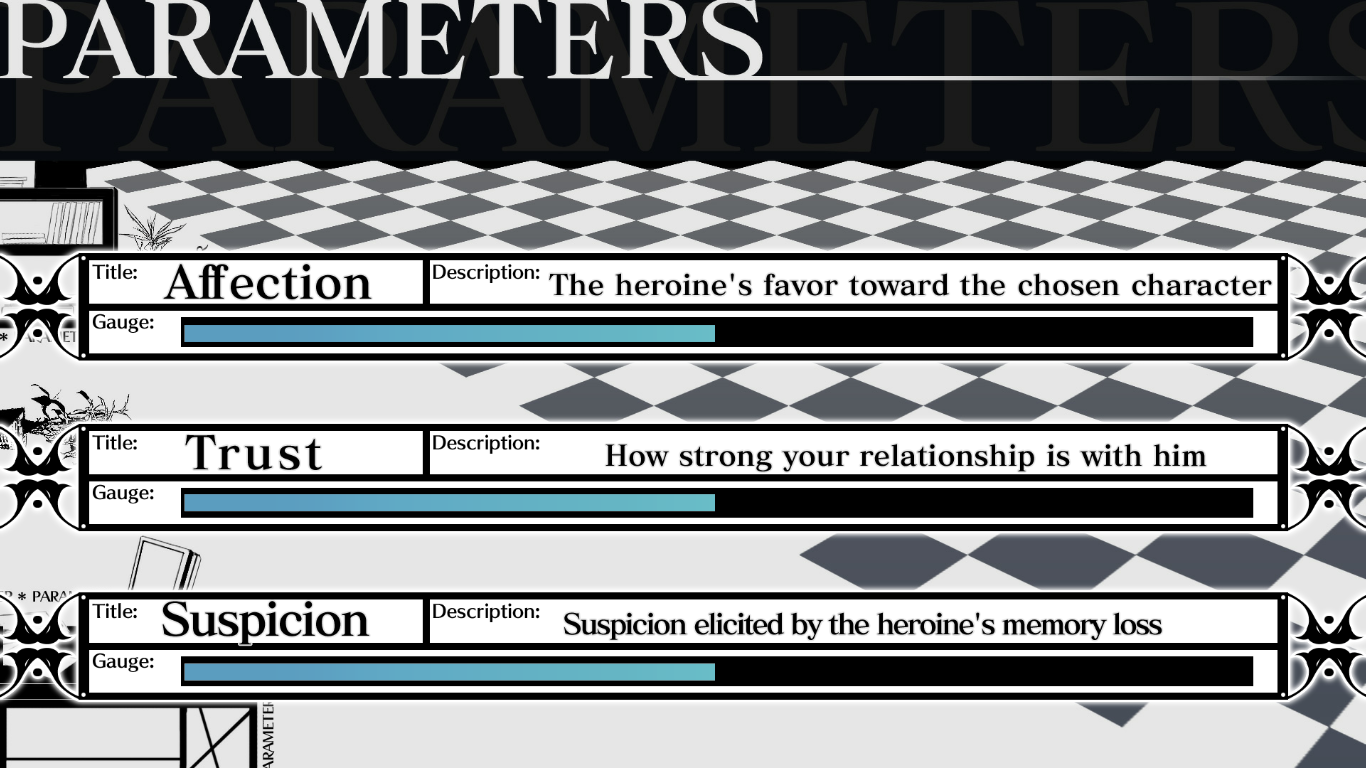
gallery and a skip function. On top of this is has an in-game
tracker for the affection, trust and suspicion of your chosen hero
which is useful when it comes to figuring out what choices raise each
value. There is one strange feature in this package and that is a set
of mini-games only available on the main menu. These are incredibly
detached from the rest of the game's content to the point where you
would question why they even exist, but I suppose they are there for
those who want a distraction from the main game. Regardless, those
playing Amnesia will not find it wanting on the systems level and most
likely will not notice any potential improvement which could have
been made.
 |
| You will be staring at this menu quite a lot. |
Verdict – 7/10 –
Amnesia: Memories is a game as much distinguished as harmed by its
commitment to creating tension and immersing the player in the role
of the protagonist.
Pros-
+ The male leads give a good variety to narrative and the types of
relationships on offer to the player.
+
A satisfying final route which raps up all the hanging plot threads
in a nice bow and feels suitably final.
+
One of the strongest uses of a self-insert to sell the bond between
player and protagonist and create a palpable tension through the unknown.
+
The art style adds a dream like quality to the game and helps sell
the atmosphere and the romantic fantasy.
Cons-
-
Having a self-insert protagonist can hurts character interactions and
leads to some stilted scenes.
-
At times it can be a blatant buffet of hot men for the player to
choose from to the point of being off-putting.
- A mediocre soundtrack and lack of interesting technical features hold the game back from being a more well rounded package.


 Posts
Posts

