Tsukihime -A piece of blue glass moon- (Remake) Review – Reimagined Under A Brilliant Moon

Genre – Urban Fantasy, Suspense, Horror, Action Play Time – 30 hours Developer – Type Moon VNDB
Will It Disappear At Dawn?
The
remake of Tsukihime was once considered a dead project by the fanbase
due to how long it took to show any results to the point of being a running joke. Even when it finally did
produce something the resulting visual novel only covered the first
half of the original with the second half coming later. This release
was subtitled A Piece of Blue Glass Moon and is the subject this
review. The game covers the Near Side routes, these being Arcueid and
Ciel, which focus around the greater world of Tsukihime with its
supernatural forces on full display. In the original this was
arguably the weaker half of the game given its role to act as set up for the other routes and in particular how much Ciel’s route retreads a lot of Arcueid’s
route. Through this remake Type Moon tried to address these
shortcomings of the original 2000s title and create a definitive
version of their first work with the bells and whistles provided by
modern techniques and a vastly bigger budget. Was the wait worth it
or does this vampiric tale burn in the light of day? Let’s skulk
under moonlight and find out.
Once Again Walking With Death – Narrative and Themes
As
a remake there are certain expectations the game inherits from the
original when it comes to content, characters and overall theming.
This is a strong and well defined legacy to inherit and there are
times when you can feel the game struggle under its weight as it can
occasionally give certain moments more emphasis then they deserve.
However, overall the title is a broad success in terms of preserving
and enhancing the elements which made the Near Side so distinctive,
these being a commitment to psychological and vampiric horror, a leaning
towards action and world building. For Arcueid’s route this hold
especially true since the game copies much of that route verbatim
with the only real alterations being made on the moment to moment
interactions between characters, otherwise this revision is faithful
to a fault. Beyond the adhering to the original there is an
understanding of what the new technology can bring to older scene
that enhances them in a such a way that you know the original would
have done the same if it had the ability to do so. This includes the
proper use of movement, lighting and camera angles to sell the
emotion the text is trying to invoke in a subtle way so as not be as
unnoticeable as it is powerful. The effect these enhancements have in
making the remake seem more like you remember the original cannot be
overstated and is one of the game’s strongest aspects for returning
fans.
 |
| Ciel is by far the character who benefits the most from the remake |
On
the opposite side we have the many changes the remake has made in
order to rectify the flaws and limitations of the original work.
These includes range from minor things like the reordering of events
to make more sense and the expansion of certain character moments to
increase their prominence to the wholesale rewriting of Ciel’s
route. The original version of Ciel’s route suffered from borrowing
too much from Arcueid’s route and a general sense that it had been
rushed so it was a perfect candidate for a reimagining to bring out
the potential of Ciel’s character. However, rather than throwing out
the entire original route, the broad strokes have been preserved and
the new material fitted around them so as to maintain the identity of
Ciel’s route and offer a little subversion for returning players.
The new additions to the route revolve around exploring Ciel’s past
in a more expansive way which was a previously lacking area. It does
this through having more character’s related to the Church being
present for Ciel and Shiki to interact with and by drawing more
parallels between Shiki’s plight and the experiences that have
shaped Ciel into the person she is today. These touches do wonders to
improve upon Ciel’s characterisation and give the route a much
needed identity distinct from Arcueid’s route. The revitalisation
of Ciel’s route is by far the game’s greatest success and the
main reason to play it if you have already played the original.
This
reimagining is accompanied by a need to be bigger and better than the
original, even more so when it is only half of the overall narrative
of that first game. Due to this need to fill space the remake can
often extend scenes beyond their natural ending and adding in fluff
events that are cute but do nothing to progress any part of the game
forward. This is most noticeable in Arcueid’s route where the
changes to what was a tightly paced experience are more obvious due
to the way they temporarily grind events to a halt to accommodate
them. While downtime is necessary to keep the player from burning out
from all the tension and high stakes, there is a difference between
having these moments further character dynamics and just repeating
the same basic jokes or adding in long-winded monologues that do
nothing to engage the player. Throughout other parts of the game
you can feel similar occasional hiccups in pacing and they
temporarily bring you out of the story as they put on the breaks in a
highly unnatural manner. However, they are overall uncommon enough as
to not destroy the game’s core narrative and are instead a series
of minor nuisances.
 |
| Umm... are you okay Shiki? |
Power
level might seem like an odd thing to bring up as a criticism of a
game which has always had its fair share of action, but it is in the
inconsistency of that power level where the biggest issue with this
remake lies. The problems manifest at two distinct points, fights
related to the vampire Vlov and the final battle at the end of Ciel’s
route. These conflicts are almost apocalyptic in scale and feel so
detached from the rest of the game which deals in relatively down to
earth and deadly threats. This is especially strange when considering
our protagonist Shiki is presented as fragile and human outside of
these battles but inside them he displays an ability to fight and
survive damage he never uses outside of these moments. Vlov is the
bigger offender since he is in the middle of the narrative meaning
that the power level spikes when he appears and afterwards drops like
a stone back down to its original levels. This causes a strong
sense of whiplash and a feeling that Vlov does not belong with the rest
of the game making it obvious he is a new addition. The final fight
in Ciel’s route at least attempts to justify why the power level
spikes, but its problem is the jump is just so ridiculously large with
the strength of the characters involved moving from vaguely realistic
to completely over the moon in a short space of time. It seems to be
this way so as to have a big finale for the game since it now lacks
the second half and must end on some kind of resolution to provide
catharsis for the player. Since these two examples constitute a very
small amount of the overall play time it would be misleading to say
they ruined the game, but the poor way they were handled as part of
the whole narrative does leave a sour taste in your mouth as it kicks
you out from enjoying what are in isolation very impressive fights.
However, they feel like the belong more in Fate Grand Order than they
do in Tsukihime.
Of Vampires And Mortals – Characters
The
majority of the remake’s cast is inherited from the original
Tsukihime and they are as distinctive here as they have always been.
Time has been kind to the main characters, they have remained
relatively unmolested by imitators or an obsession with moe and feel
as fresh as they did back when the original was released. Having a
protagonist like Shiki at the helm helps a lot since his mixture of
kindness, violent urges, supernatural powers and physical weakness
makes for a soup from which a variety of character arcs are possible
and provides things for the heroine’s to bounce off to create
engaging dialogue. He is at once likeable and interestingly flawed
which makes seeing events through his eyes an entertaining journey
and his mortality adds stakes to every confrontation with the world
of vampires. The two main heroine’s of the game, Arcueid and Ciel,
strike the right balance between being proactive driving forces for
the narrative and being vulnerable enough that it is believable for
them to need Shiki both emotionally and as backup in battle. Beyond
this the rest of the returning cast have mostly background roles in
this game but even here they showcase a degree of complexity while
hinting at what is yet to come. Together they are as memorable as
always and the remake captures why they entranced so many people over
the years.
 |
| Noel is an... interesting character |
As
for the new cast members introduced in the remake, those which are
directly involved in the plot work to expand the horizons of the
narrative and provide a more well rounded character experience. They
are mostly related to the Church and thus shine in Ciel’s
route, but make enough of an appearance in Arcueid’s route so as to
not appear out of nowhere when it is their time on screen. Their
existence is an effort to give Ciel and Shiki some characters to
interact with who relate to the side of the world Ciel exists on
which the original was sorely lacking. For example Noel acts as
Ciel’s work partner and is a complete contrast to Ciel’s
personality being a strange mix of cowardice and adult, almost
predatory, charm. This makes her an excellent character for Shiki to
interact with and receive information that Ciel would not be willing
to give up and allow Shiki to express feeling through an outlet
beyond the main heroines. All the Church related cast broadly act in
a similar manner and allow for a richer understanding of the world,
past and beliefs of Ciel that were not properly explored before. It is in the new content that they shine their
brightest and showcase the wonders well constructed additions can do
to breath life into existing stories.
 |
| Oh boy is this guy creepy |
Not
all the new additions are used quite as effectively as those related
to the Church and these are the characters who are in the waiting
room for their important role in the next game. They mostly relate in
some way to the Tohno household which is the subject of the Far Side
routes but is only loosely touched upon in this game. As
such they appear repeatedly in the common route before mostly
dropping off the face of the earth as soon as a heroine route starts.
Saiki Gouto is a good example of this as he is introduced early on
with a unique antagonist relationship with Shiki and his abandonment
of the Toono family. After this he appears a couple more times to
deliver cryptic messages and veiled threats and then he is never
heard from again. He is probably the most blatant set up for next
game character in the entire visual novel and this makes he come off as a
distraction which is wasting the player’s time since there is no
pay off to his presence. On top of this it gives a general sense of
the game being only half finished which is not something you should
be regularly remaining the player of while they are trying to enjoy
what is here.
A Revitalised Full Moon – Visual, Audio and Technical
Visuals
and audio were never the strong points of the original Tsukihime so
any improvement to them would make the remake stand out against it.
However, rather than simply replacing the identity of the original’s
visuals and audio, the remake takes them as a basis to improve upon
and regularly invokes these elements of the original through subtle
nods or complete recreations. Above all else it brings these aspects
of Tsukihime in line with the standard of modern Type Moon and makes
them more accessible to a modern audience. There is a surprising
amount of movement on display as the characters display a dynamic
suite of positions and expression for their portaits to sell
everything from the power of a blow to their hidden feelings. This
move towards the unifying of the game’s style with the rest of the
developer’s catalogue does come with an occasional hiccup where
certain characters can look very similar to character from other
games they have developed. Arcueid and Shiki suffer from this when
they drift into looking like Saber and Shiro respectively and this is
very distracting when you are trying to be invested in these
characters. On the musical front, the majority of the tracks are
entirely new since the original only had a handful of songs, but some
of that old catalogue is maintained here in the form of remixes and
bringing in motifs from them. In combination they make for delightful
soundtrack perfect from enrapturing both new and old fans.
 |
| Flowcharts are important for a more complicated visual novel |
On
a broader technical perspective, the remake makes use of a variety of
presentation and accessibility elements to create an experience that
is both tense and flows well. The choice of NVL as the game’s
formatting style carries over from the original and is as good here
at building atmosphere as it was before. There have been a few
touches to make the potential walls of text more intelligible through
having only the most recent line of text be bright and all the
previous ones take on a darker hue to ensure clarity. In line with
this move towards lucidity, a flowchart has been included in the game
which allows for the player to see their progress, the consequences
of their actions and jump to any unlocked scene at will. This lets
the player navigate through the game without having to worry about
constantly saving at every choice and wondering what action caused
what outcome and, with the return of the helpful Teach Me Ciel
Sensei, every effort has been made to ensure the player is never
lost.
Conclusion
Tsukihime
is certainly a game that needed a remake, but it is also a game with a
lot of exceptions and baggage attached to it and for the most part
the remake does a good job of capturing the essence of the sections
it adapts. It is at once faithful to the original while taking on
board new ideas to improve the weaker elements of the base game. In
doing so it does run into some issues with how it handles the power
level of the game which leads to a feeling of inconsistency at times.
The old characters continue to be as charming as ever and the new
additions who stand out here share a similar level of quality. There
are some new characters that exist as set up for the next game and
they feel really out of place here given they have no real role to
play in the narrative. From a visual and audio stand point the game
is a dramatic improvement over the original and breaths some much
needed life into it. Modern conveniences have also been included in
the remake with things like a flowchart making for a more streamlined
and smooth experience. This is about as good a remake of Tsukihime as
could be expected and with the second half coming at some point it
will be interesting to see what the complete title will look like.
Verdict –
A gold standard for visual novel remakes which captures the essence of the original while not being afraid to improve upon its weaknesses, even if it does stumble under the weight of these changes.
Pros -
+
Faithful to the narrative and themes of the original visual novel.
+
Adds additional content where needed to expand upon the weaker elements
of the narrative, in particular with Ciel’s route.
+
The old cast is as memorable as ever and they are joined by a set of
new characters who wonderfully fill holes present in the original
game.
+
Having a modern coat of visual and audio paint does wonders for the
effectiveness of the emotional beats.
+
Modern accessibility features such a flowchart allow for a smoother
recovery from any potential bad endings.
Cons -
-
The inconsistent power level of the battles can draw you out the
experience and make it difficult to suspend your disbelief.
-
Not all of the new cast are utilised in this game and many of them
exist as set up for the next title.
-
Having a modern Type Moon art style can sometimes lead to characters
looking eerily similar to ones from their other games.
-
The new content can make the game feel bloated at times.
Best Visual Novel Releases – August 2023

As
the last days of summer come to an end and the cooler Autumn breeze
begins to blow, it is time to see what the scorching heat has left
behind this month in the world of visual novels. There have been a
number of interesting releases from both the official and fan spheres
covering everything from musical romance to jousting drama to
supernatural thriller. These each bring something unique to the
visual novel buffet and the best among them are presented here for your
pleasure. Let’s welcome the cooler weather and look at what the
medium has to offer.
Official Releases
WHITE ALBUM: Memories like Falling Snow

Originally
released in 1998, this visual novel is one of the most iconic romance
titles of the period with its striking and delicate tale of pure
love. The version now available is a later remastered edition which
gave the old game a much needed face lift to help sell it to new
audiences. It follows our protagonist, Fuji Touya, as he grapples
with the new found idol stardom of his long term girlfriend and the
troubles this brings into his life. Whether this is to results in him
remaining loyal or finding comfort in another is up to the player as
they guide him through this roller-coaster of emotions. Music and the
idol industry are utilised well here to give a sense of conflict and
substance to the trials facing the characters and while it is not the
deepest examination of the industry it still presents it in an even
light with considerations for both sides of the argument. If you ever
wondered what the granddaddy of romance visual novels looks like now
is your chance to find out.
Mandemon

This
is a strange one, a short, atmospheric thriller visual novel that
leans heavily into its oppressive undertones to sell its narrative. Yet
there are more layers than it a first appears and overall it will
leave a lasting impression through its economical use of the limited
space available. Focused around the presence of the titular mandemon
and the murder which has invaded the characters’ lives and
threatens to consume them in its madness. There is not much that can
be said about this game due to its reliance on twists to support the
experience and how small the game is, but the package does come
together in a surprising competent way and is a good means to burn a
few hours having fun as you hold your breath wondering about what is going to
happen next.
Norn9: Last Era
Nintendo Eshop VNDB Genre
– Otome, Fandisc Play Time – 35 hours

August’s
standout Otome title is the fandisc to the excellent Norn9 and
continues that game’s high narrative standard while expanding on
the characters. The game is split into three sections, Concerto Kyousoukyoku, which is your standard after story fair, Fuga Tonsoukyoku, a section featuring tales from the male
perspective, and Fantasia Gensoukyoku, that looks at the
dangers of indulging the desire to consider the what-ifs. Together
they fill in the remaining holes left by the main visual novel and
provide some much needed alternative perspectives on key ideas and
emotions. Overall, this is a must have for fans of the original but
as you might expect offers nothing to a new player who is better off
looking to the original to their otome fix.
Clover Day's Plus

If
White Album is the strength of an older school of romance visual
novel then Clover Day’s is a testament to what the modern approach
to the genre brings to the table. At first glance there might not
seem to be anything special about Clover Day’s. It opens and
presents itself in the way we have come to expect from the romance/
slice of life genre with its emphasis on promises, established
character relationship and the expected group of girls vying for our
protagonist’s attention. However, what set this game apart is the
sincerity with which it presents these bugging relationships and how
it play on the themes to explore what each bond means to those
involved in it. Promises and what it is to keep them define the
characters quest to understand their feeling and work towards their
happiness. Clover Day’s is truly an example of how to do the genre
right and put the soul into your characters that will make them leave
a lasting impression of the player.
Fan Translations
Planetarian ~Snow Globe~
Patch Download VNDB Genre
– Sci-Fi, Slice of Life Play Time – 2 hours

Being
the prequel to one of the most beloved short Key titles is a tall
order and doubly so when that title was a complete experience in
the first place. Such is the position that Planetarian ~Snow Globe~
finds itself in and rather than trying to stand up to match the game
it leads into, it instead decides to forge its own short and sweet
tale. The result is a story using familiar elements and places from
the original game and tells a non-essential narrative within the
universe. If you walk into this game expecting another game as heart
wrenching as the original Planetarian then you are in for a
disappointment as it aims for a much lower bar of quality. Despite
this difference there is a tight story of a normal world in the not
so distant future and a small look at the lives lived there. If you
can meet it on those terms then there is a few hours of fun awaiting
you.
Walkure Romanze ~Shoujo Kishi Monogatari~
Patch Download VNDB Genre
– Romance, Sport Play Time – 30 hours

Visual
novels are no stranger to basing themselves around off the wall
sports or even fantastical ones like in Aokana, but there is
something particularly odd about Walkure Romanze’s choice of
jousting as its core element. Even more so when the entire school our
protagonist goes to is fixated on it as its sole sport. There is a
definite need to engage one’s suspension of disbelief when playing
this game as it makes no attempt to justify why this state of affairs
is even possible and seems more interested in girls in knight armour
on horses. Despite this the jousting gives strong a strong sense of
identity to the title and is merged into the character arcs in a
satisfying way in not too dissimilar to its stable-mate Aokana. The
emotional stakes are shaped in just the right way in order to ensure
the climax of the story and sport match where they need to and
provide a well rounded narrative.
Bloodstained Flowers
Patch Download VNDB Genre
– Murder Mystery, Trapped Play Time – 3 hours

There
is something about the trapped/ survival plot that holds a unique
appeal in the way it can bring out the many sides of its characters
by placing them under extreme stress. Bloodstained Flowers offers a
condensed version of this formula and leans heavily into the murder
mystery genre to keep the player guessing. The story follows the
members of the Mystery Club as they go to the Utsugi Mansion where a
group suicide is said to have occurred, but it soon becomes clear
that their lives are in danger as the pollen of a strange flower
threatens do be the death of them all. With the desperation of the
situation established, all sorts of hidden secrets come to the
surface and intrigue ensues alongside a healthy among of bad endings
to spice things up. Bite sized goodness is a running theme this month
and Bloodstained Flowers provides the staples of its genre in a
condensed time-frame.
Gacha Mechanics – An Anatomy Of Visual Novels

What Is In The Box?
One
of the latest and perhaps most contentious recent development in the
sphere of visual novels is the rise of gatcha mechanics as one of the
prominent elements in the design space. Leaning heavily into the
mobile market, they involve spending currency for acquisition of a
selection of random characters and items from a set pool with
rarities attached to them. For such a seemingly simple mechanic it
warps everything around it to help it function properly and this
is doubly true for its inflence on visual novels since they both share a focus on
characters. The gacha demand a continual stream of content and a story
without an end with a desirable cast and it does not care about the
form all of that takes so long as it feeds the player back towards the gatcha. This might sound like a wholly negative influence but it does
allow for the flexibility and inventiveness of visual novels to come
to the forefront. The success of gacha from a monetary perspective
means it is likely here to stay and, while a discussion of the moral
and financial impact is beyond the scope of this article, it is
something you should hold at the back of your mind because as they
say, money speaks. Let’s be mesmerised by the pretty lights and see
what gacha brings to the table.
The Never Ending Story
In
order to continue to keep player interested gacha mechanics must have
a constant stream of new characters to
tempt the player into trying to acquire them. As a character
without some sort of complimentary narrative holds little appeal on
anything other than an aesthetic level, the demand falls on the
visual novel to provide stories for all these new characters. The
result is a kind of never ending narrative constructed of smaller
sections focused around the current gacha characters before they are
put aside for the next batch. This is not to say that there is no
overarching story or constant characters, in fact many such games
rely on the intrigue of their plots and likeability of the central
cast to keep players hooked from one section to another and not just
drift away once they have the character they wanted. Instead there is
a form of plot stretching that occurs where narrative elements are
drawn out for as long as possible and this is often accompanied by
the introduction to more villains after the previous lot have been
defeated or moving on to a new land in pursuit of some related
threat. These choices are a means of reducing the workload, which
would be immense undertaking due to the constant need for new ideas,
through the use of a manageable framework of concepts established
early on and adhered to so there is a clear direction.
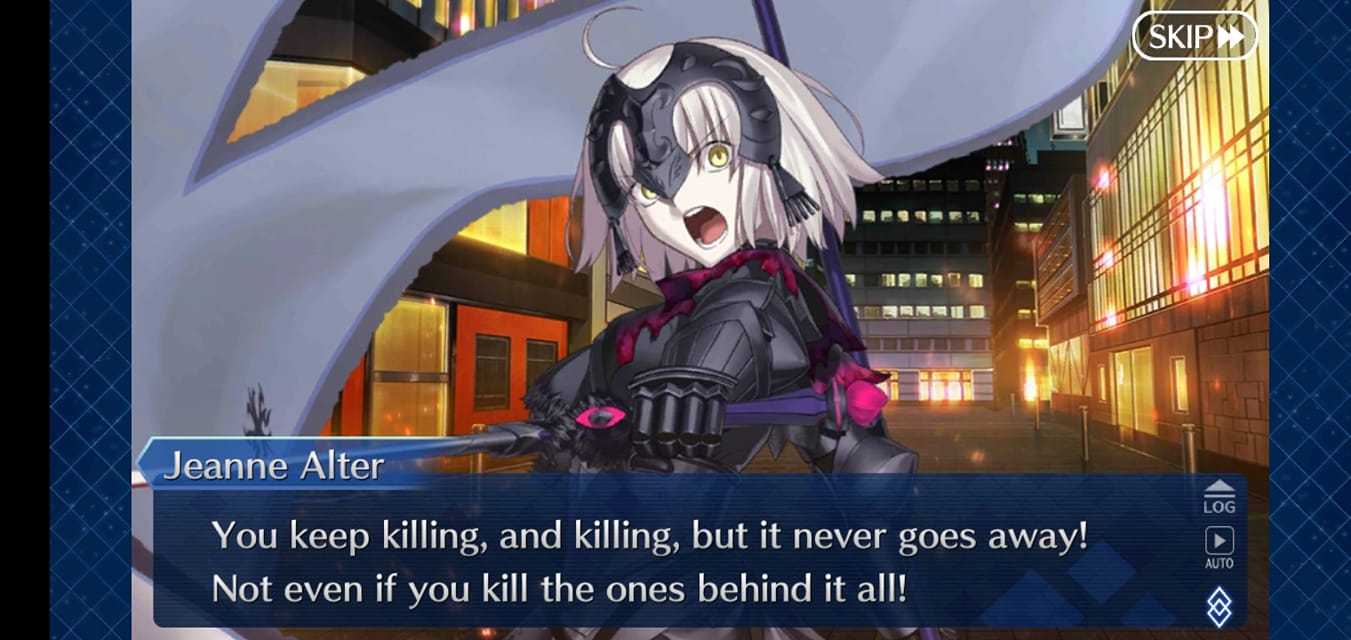 |
| Best girl? |
From looking at
Fate Grand Order we can see the method and implementation of these
ideas. It broadly has two super-sections in the form of the original
story arc and the Lost Belts which each follow their own overarching
repeated plot structures and this enables
new parts to be produced quickly. Variety is still present within
their sub-sections as they are given licence to alter the formula to
meet their needs, so they feel familiar but not to the point of openly
breaking the believability of events. The problematic impacts of this
repetition are easily visible in the original story arc where it is
clear the developers had no idea how to properly work around the
shortcomings of the gacha's demands and the result is each sub-section’s content being
thinly spread out and an uneven character representation. With more
experience this would be resolved by the time of the Lost Belts, but
even there you can still sometimes feel the stretch this form of
narrative design demands. While repeated structures are not unique to
gacha style games, they do rely on it in a manner that few other
mechanical elements demand.
Desirability At The Cost Of Humanity
For
a player to want to acquire a character from the gacha mechanics they
must find them desirable both in terms of aesthetics and, often more
importantly, the likeability of their personality. This leads to a
unique design problem for visual novels where any character who will
be part of the gacha cannot have any of the more meaningful negative
aspects of humanity, such as avarice or cowardice, and if they do it
is a toned down version which is treated as little more than a cute
trait. Couple these issues with the fact that villains can also be
part of the gacha and there are few spaces where the other side of
human nature can be explored. On the flip-side, having the heroes and
villains closer leads to a more even feeling narrative with there
being no simple ‘bad guy’ and instead just two sides who want
what is best but have different ways to achieve this end. However,
even can also be one note and since all these characters lean
towards certain traits there is a monotony to their predictable
actions and they lack any real sense that they are living people like
the player.
 |
| Heroes has an... interesting story... |
Fire Emblem Heroes is a good example of this design
conflict due to the presence of lots of already pre-established
characters from the franchise and the addition of a few new ones. The
cast members from the main line games are shadows of their former
selves with all their human flaws smoothed off out of fear that they
might alienate potential players. These characters offer nothing of
value to the narrative and exist purely to look pretty and play off
people’s nostalgia. As for the new characters, they fair noticeably
better as they are not bound by the need to appeal to existing fans
and they can express a humanity not present elsewhere, making them the
heart and soul of the game. On rare occasions there are characters
who are allowed negative traits in the gacha mechanic such as with
Columbus from Fate Grand Order. However, even he is not allowed to
remain that way for long as in all his appearances after his
introduction he has had his negative aspects pushed into the
background or skirted around, causing his lose much of his identity.
Flexibility Beyond The Original Scope
The
ever present demand for more visual novel content to support the
gacha mechanics has the interesting side effect of allowing for a
variety of tones and subject matters that would seem out of place in a
normal visual novel. These generally takes the form of events or side
chapters that have only a tangential relationship with the main
narrative and include things such a seasonal episodes or stories
focused around side characters and world building which would
otherwise not be covered. They exist to fill the gaps in between the
major content releases and their nature as extras changes the
player’s expectations towards them and results in the players accepting them as they are rather
than expecting them add to the greater whole. From this freedom is born a
flexibility not present in non gacha games to the same extent or with
the willingness to step outside the original scope of the game and
push the overall narrative into new and exiting places.
 |
| Never trust the sea. |
Perhaps the
most interesting example of what can be achieved with this extra
content is Arknights. It has the suite of seasonal events that have
become standard in the gacha sphere with the usual parade of
swimsuits when summer comes around and these basic type of events
serve their purpose as pallet cleansers. However, what is more
interesting is the way Arknights utilises its events to expand the boarders of its world as it brings in everything from lovecraftian ideas to 20th
century space sci-fi elements in order to complement the strong core
narrative. It is one of the games most willing to push the envelope
on what kind of interesting genres it can bring into itself in order
to further the world building and it has made it one its selling
points. Without the space and freedom provided by the gacha mechanics'
constant demands for content these elements would not have been
possible since they rely on the nature of the game’s content
delivery schedule to be accepted by players.
Limitations Are Where Visual Novels Are Most At Home
Many
games that use gacha mechanics exist within the mobile phone space
and their pairing with visual novels often comes down to a need to
account for the lower power of many of these machines. Above all else
visual novels are excellent at making a lot out of a little and
creating a compelling story from what might seem on the surface seen like a
limited tool set. They are also better suited to the pick up and play
style of game that is expected in the mobile sphere due to their
ability to quickly load, present their narrative and finish just as
quickly while also allowing for a longer form where needed. The
narrative of many games with gacha mechanics tends towards a node
based structure with an equal mix of visual novel and gameplay and
they are often disguised as points on a map or some other in universe
concept. This presentation helps set up what the player should expect
from the length of each section and gives the visual novel element a
known limitation to work with to ensure it adheres to the required
length. As phones become more powerful there will be a move away from
using visual novels as the means to telling a story and onto more
traditionally ‘cinematic’ or rpg styles of presentation. The
first steps in this process can be seen in games like Genshin Impact
which lean heavily into other game styles for their narrative, but
even then there are trace elements of the influence of visual novels
to be found in the way the hangout events are constructed. Then there
is the matter of screen size and how a visual novel can be a clearer
method of presentation, with its simpler shapes, lack of unnecessary
movement and dialogue focus, than other styles which would lack
clarity as they are compressed into a smaller space and are more
indistinct as a result.
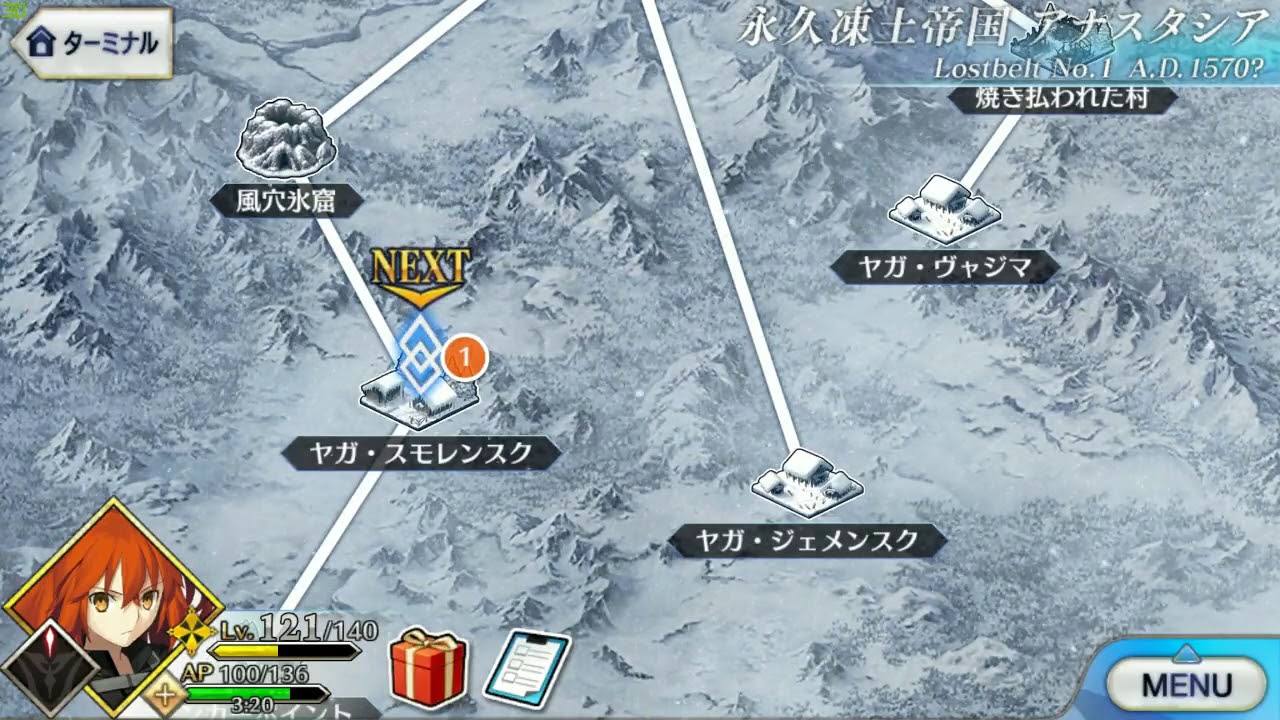 |
| Node based structure is design space born of the pick up/put down nature of mobile gaming. |
Conclusion
Gacha
mechanics have had a fascinating influence on the uses and forms of
the visual novel. Their demand for a never ending story to feed the
new character treadmill causes a strange mixture of short term
character focus and repetitive long term narratives that create and
distinct contrast with one another. Alongside this is the need for
all the gacha characters to be desirable and avoid the darker
elements of humanity which has the effect of making the heroes and
villains relatable, but also lacking in the flaws we all have,
resulting in a somewhat tragic villain leaning method of
storytelling. However, the flexibility offered through the demand for
content not caring about the nature of this content allows for a
wider field of narrative genres to be explored to enrich what is lost
through the other limitations. The very choice to use visual novels
at all with gacha mechanics is a result of hardware and screen size
limitations that make it an excellent fit from the technology. While
introducing a gacha into your own game might be too much of a
herculean task for most developers, it is nonetheless interesting to
see how adaptive and innovative visual novels can be when put under
pressure.
Comedy VNs – Genre Deep Dive
I Laugh, You Laugh, We All Laugh
Making
people laugh is a particular talent and more than any other it is
dramatically effected by the medium it is presented through. Stand up comedy
and visual novel humour might share a similar desire to entertain but
they could not be further apart in terms of how they reach that goal.
The unique set of tools available to visual novels has led to a
striking set of games which would not be possible in any other
medium. This stems from several factors, from their relative length to
the importance of thematic resonance to many visual novels, all
working together to tickle the player’s funny bone. For this
article the definition of a comedy visual novel will be narrowed down
to games which rely on humour as a core pillar of their content and
without it they would not be able to support themselves, such with
Lamination. This excludes most slice of life visual novels that use
humour regularly as a flavour rather than the main dish, but not
those like Maji Koi where jokes are a strong enough part of their
identity as to feel lacking in the absence of humour. Such an interesting
spread should reveal much about the nature of the comedy visual
novel, so let’s roll on the ground laughing and see what we can
find.
Subjectivity Of Humour
Everyone
has their own tastes and nowhere is this more obvious than with
humour since what one person laughs at another might find boring. As
such focusing your entire identity around humour runs the risk of
alienating potential players when they bounce off your brand of
jokes. Of course a developer could simply accept this eventuality and
lean into the people it will attract by going all out to please them
as Lamination does, but many other comedy visual novel instead opt to
lean on other parts of visual novel design to spread their net as
wide as possible. These often take the form of a secondary genre to
act as a backdrop and spice the jokes up as they can rely on or
subvert established ideas to create a variety
to their humour without compromising its core brand. Sankaku Ren'ai:
Love Triangle Trouble! and Rance represent the two extremes of this
philosophy with the first leaning into school slice of life and the
other high fantasy. However, despite their differing host genres
these games both utilise them to smooth over possible flaws in their
respective comedy. For Sankau Ren’ai this involves leaning into the
romcom nature of slice of life and cracking it up to match its banter
centric humour while also providing a through line of drama for every
player to latch onto so they can push past jokes that do
not land for them. Similarly, Rance takes its fantasy setting and uses
it to give the events of the story meaningful weight even as the game
often mocks the inherent absurdity of the genre’s tropes. Since
both are done with an unwavering commitment they act as counter
balances to allow for a well rounded experience to keep the player
interested in the jokes.
 |
| This feels so wrong... |
A
strange offshoot of this problem of player retention is the spin-off
comedy game which takes an established game series and inserts it
into a silly setting. In doing this a developer can guarantee an
audience from that previous title rather than risking an unknown new
game as the host for their comedy visual novel. Having established
interest is not the only benefit since these people will come into
this game with a set of expectations meaning this type of visual
novel often leans heavily into subvertion as a
source of humour. This can be seen in games such as Corpse Party:
Sweet Sachiko’s Hysteric Birthday Bash and Idol Magical Girl Chiru
Chiru Michiru which take the identity of their IP and put an absurd
spin on it to get the player laughing. Whether this be a magical girl
version of a fan favourite character or a harmless birthday party in
what was previously a death trap riddled school, there is a sense of
being in on the joke held between developer and player in which both
accept the non cannon nature of the work and agree to have a good
time reminiscing about how far the series has come by showcasing its
strong characters.
The Thematic Resonance Of A Good Joke
Laughter
is a powerful means of getting a people to bond with characters and
consider ideas in a new light. In the playful atmosphere we are taken
in and lower our guard in the face of what seem to be harmless fun
and it is in this state we become susceptible to engaging on a more instinctual level with what
is presented to us. Just as the jester
delivers news the king does not want to hear, so too do comedy visual
novels utilise the same techniques to put the audience in a trance.
Making jokes and laughing alongside our friends and family is a
natural part of everyday human interactions and emulating this is
what lends comedy much of its strength as a means of creating
empathy. Two visual novels which have a large reliance on this aspect
are Lamination and Marco & The Galaxy Dragon and these share the
common trait of doing so through the absurdity of their events. Lamination
takes a relatively grounded setting and has its character do things
that seem insane but are delivered in a straight faced way by the
cast, so it feels as if this is the most natural outcome in the world
and in accepting their silly actions the game snares the player’s
heart. The setting of Marco & The Galaxy Dragon is decidedly more
overtly not related to our real world and rather than take the banal
and ramping it up to insanity, it instead starts at that high point
and keeps going up in ways the player is likely not expecting.
Through a journey of hilarious surprises, it forges the bonds between
the player and its characters and ideas since they are presented as
an extension of the comedy. Of course you do not need to be out of
the box in order to achieve the same resonance as Starry Flowers
demonstrates with the intimate and cute humour that aims to warm your
heart and through this make the joke carry emotional weight the game
would otherwise lack.
 |
| Sometimes cute and funny is all you need |
Comic Fatigue
A
joke can only remain funny for so long before it wears out its
welcome and becomes tiresome and predictable. This is doubly true
when a brand of humour is played out over a long time as there are a
limited number of variations that can be formed to keep things fresh
and stagnation often follows. Such is the fate every comedy visual
novel is trying to avoid and broadly speaking there are two solutions
found in these games, keep the length down to not run into this
problem in the first place or rely on bringing in a narrative thread and
attaching it to the established resonance between player and
characters. In a concise structure the humour can focus on hitting as
hard as possible at all the times since the player will have completed
the game before they can become burned out on it. This is the most
common approach to comedy visual novels and can be seen in titles
like OshiRabu: Waifus Over Husbandos which embrace their short
duration as part of their identity to create satisfying morsels to be
enjoyed for their intense flavour then cast aside and forgotten.
Having such a direct angle to their humour does intensify the issue
of a player bouncing off the experience due to it not matching their
tastes but the lower cost of production ensure this does not lose
enough revenue to effect the end product.
 |
| Taking a joke and making it resonate with the player is a powerful tool |
Taking the opposite
approach of relying on additional narrative elements to supplement
the comedy and allow it to maintain itself over a longer play time
changes how the game is constructed. The more intense bouts of humour
tend to be focused in the opening sections such as the common route
or the beginning of a heroine route and slowly shift into a more
supportive role before coming into focus again after the main
conflict has been resolved. Maji Koi is the poster child of this
school of comedy visual novel with it being joke centric for most of
its duration, but knowing when it has to take the foot of the pedal
and give the player a substantial character arc for the heroine. By
mixing these narrative elements with the already established
resonance between the characters and the player formed through the
jokes and laughing alongside the characters, the game binds together what would
otherwise seem to contrasting tones.
Conclusion
When
talking about comedy visual novels there is the temptation to dismiss
them as simple in nature, just pushing out one joke after another
with no sense of greater purpose, but as has been shown this is far
from the reality. The risk brought about by the subjectivity of
humour makes many such games adopt a secondary genre to act as
background to prevent their jokes from becoming too one note. In
doing this they can leverage their biggest strength in the form of a
thematic resonance with the player through the cathartic and
empathetic natures of comedy to sell the characters and ideas present
throughout. They also have to consider their length since the longer
a brand of humour goes on the more the player will suffer from comic
fatigue. Some aim for a short and direct experience while others
choose to lean on other narrative elements to prevent the player from
losing interest. Overall the comedy visual novel is a strange beast
which captures the strengths of the medium and introduces its own
unique challenges to form a humorous journey that hits deeply and
makes you smile.
Akai Ito Review – Blood Red Threads Of Love

Genre - Horror, Yuri Play Time - 25 hours Developer - Success Steam VNDB
Shaped By Inevitable Bonds
Being
bound by the red string of fate is a common trope in Japanese romance
stories and at first glance you might assume that Akai Ito would
follow these conventions given its emphasis on yuri. However, nothing
could be further from the truth as the game takes this romantic convention and repurposes it to further a disempowerment horror story.
Fate takes on a shade of grey with the feeling of love being tinged by the
march of supernatural forces who care nothing for this newly formed
bond. Akai Ito is very much a visual novel from a bygone era and this
makes it a strange oddity in the modern day especially with how few
games in the medium get HD remasters. Its strong core identity has
only grown in potency as its peers have fallen into obscurity and a
lack of the cliches of the current age makes for a novel experience.
Even its strange collection of design choices are not enough to sour
the overall package. With all that said how well does this mix of
yuri and horror stand up against the more varied modern medium? Let’s
follow the treads of fate and discover what this relic has to offer.
Returning To A Forgotten Home – Narrative and Themes
As
a narrative core romance and horror make for odd bedfellows and it
this exact dissonance Akai Ito uses to great effect. It utilises a
supernatural mystery as the binding element between these two halves and puts
each to good use as the source of the tense horror of being in the shoes of a weak
protagonist and for rich variety of yuri relationships. Sometimes this is pushed too far and stretches the player’s
patience with just how powerless the protagonist is even in
situations where it does not make narrative sense.
Returning
to a family home you barely remember is a strange experience with
memories slowly coming back as you explore the place where you once spent
so much time. Such is the backbone of Akai Ito’s supernatural
mystery, a forgotten past in a distant home which many people who would
rather the protagonist, Kei, forget for good. No secret can remain
hidden for long when curiosity guides the one it concerns and this
acts as the diving force for both Kei and the player leading to a
feeling of exploration and forward momentum. Each new discovery hints at
the next and passes on the sense of intrigue in such a way that the
player never feels too sure they know how this is going to end. There
is a well divided structure to the distribution of key revelations
between the routes so none of them horde all the good twists and they
are provided to the heroine with which they have a connection, so they
can be delivered believably. What this means in practice is utilising
them as a source of conflict against and between Kei and the route
heroine creating dynamic situations in which secrets flow out
naturally. In doing it this way the supernatural mystery can sit next to the other narrative elements without overwhelming them with
major plot points centred around it.
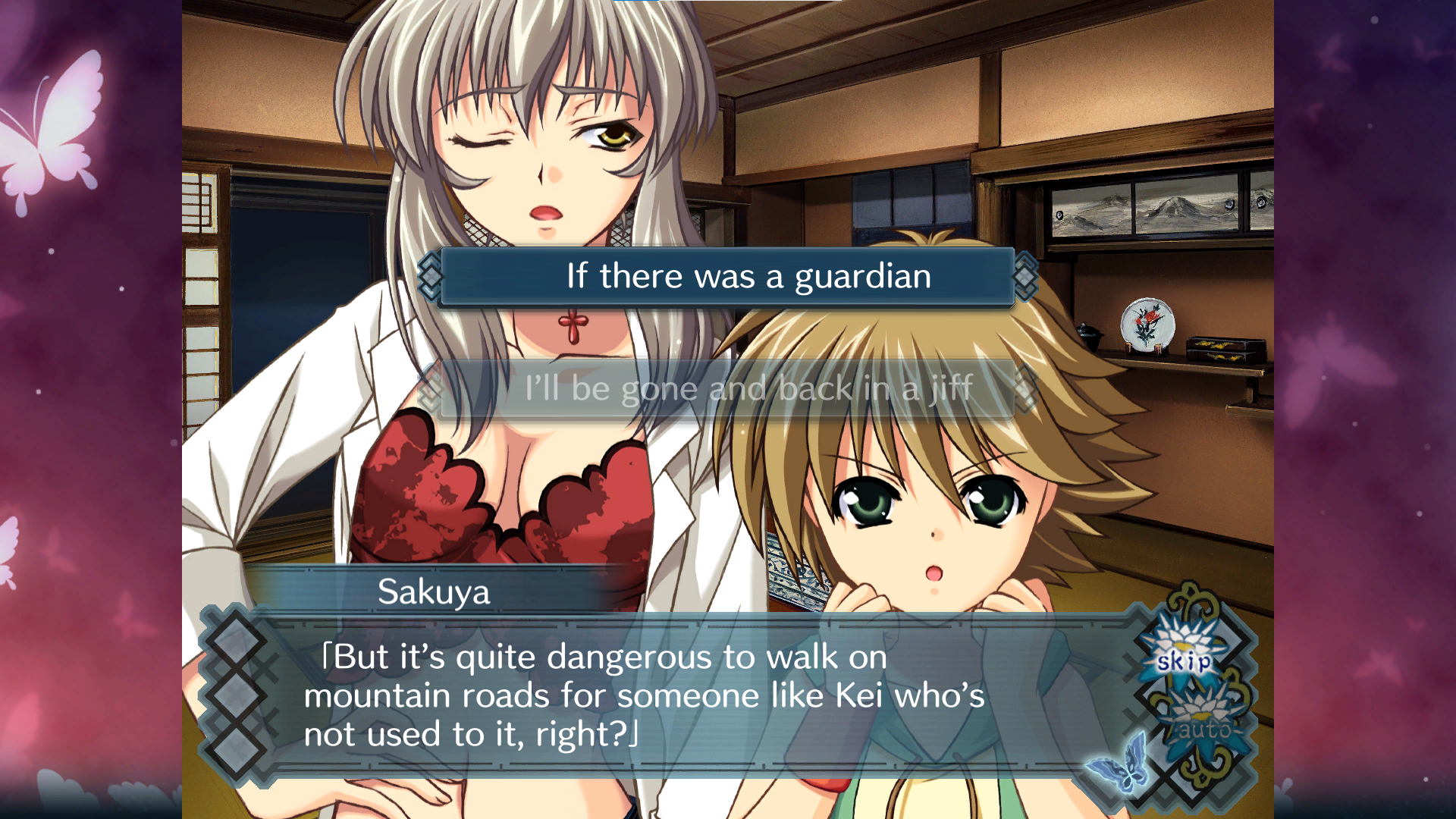 |
| There are quieter moments to contrast the mystery and tension |
Alongside
the mystery sits the game’s emphasis on a tense disempowerment
brand of horror. Kei is no superpowered fighter nor does she become so
over the course of the story. Instead she is a fairly average human
in terms of physical capabilities and this makes the threats against
her life all the more palpable. The player instinctually know the
consequences of any harm that comes her way since they too feel the
fragility of human life with each attack being a possible broken limb
at best or instant death at worse. Tapping into this primal fear of
our own weak bodies and the spectre of death in every possible slip
up is the game’s greatest achievement and it injects a visceral sense
of tension into the supernatural threat facing Kei. It feels as if
even the slightest nudge could cause this story to come to an abrupt
and bloody end. The only issue with this approach is that Kei’s
weakness can sometimes be pushed too far and she feels like a
passenger in her own story with her love interests doing all the
heavy lifting to the point of eclipsing the person who is meant to be
the main character. While this never makes itself know enough to
break the player’s suspense, it can still be distracting to see how
little our main character does at times in their own story.
 |
| Chance meetings and fate are a constant force it Akai Ito |
The
final pillar upon which the narrative rests is the yuri romances
between Kei and the heroines that drive much of the game’s drama.
Rather than following a cookie cutter formula, each romance is
tailored to the contents of the route and the personality of the
heroine. Its presentation of what it means to love another has an
extremely textured and varied nature doing a better job of examining
how the route’s pair come together than many similar games. These
range from ideas of self isolation and duty to loss and being
forgotten to family bonds and expectations. Each acts as a distinct
force pushing and pulling on the relationship to test its worth and
what it means to the ones engaged in it. On top of this, the romantic
elements know when to take a backseat when things need to become
tense or focus on pushing the story forward and what results is an
incredibly balanced overall pacing. There are few throw away moments
and Akai Ito makes the most out of the time it has available to tell
its concise ideas.
Tied Together By Fate – Characters
On
one side of the character divide with have our protagonist Kei who as
mentioned above is a deliberately underpowered character for the
threats they are facing, but beyond that they are also immensely
relatable. Their vulnerability makes the actions they take to face
the threat against their life take on a greater weight and helps sell
the human nature of their heroism. Kei is not someone who is helping
out of the goodness of her heart and instead she acts to protect and
support those she cares about, normally the route heroine. The
childish and selfish streak in her does a good job of making feel
like she is someone her age, on the cusp of maturity but still with a
lot of the emotional baggage of a teenager. For a player point of
view character, this mixture of strengths and weakness is perfect for
keeping interest constant and having a relatable point of reference among all the supernatural forces since we have all been in that cusp
of adulthood during our lives so we too know how confusing it can be.
She also works well as a mirror for the heroines since she has the
innocence that they do not and is able to see through the masks they
wear and show them their true feeling even as they try to reject her.
These bonds are reciprocal as Kei learns and matures in a way close
to the route’s heroine by taking on a small amount of their traits
so she can be more like them.
 |
| Kei can be very childish at times |
Sitting
opposite Kei is the rest of the cast, both heroines and antagonists, as
they all share a similar clear focus to their aims even if Kei is not
immediately aware of what they are or what they involve. These competing desires lead
to them rubbing each other the wrong way and results in
interesting, telling and varied interactions that do a lot to further
the mysteries at the heart of the game. The conflicts are not limited to
fighting against the antagonists and many stem from the heroines’
differing values as they struggle to contain their hostility or
unease towards each other, all the while tiptoeing around Kei. Such a
wide pool of character relationships helps support the game’s
multiple route structure as it can put an emphasis on a certain set
of struggles to make them the focus, keep them fresh and encourages a
thorough dive into each route to gain a complete picture of these
characters. The mystique surrounding the antagonists is maintained by
never revealing enough through these interactions to give away what
drives them or what they have planned, but still provide enough for
the player to form their own theories. As a whole they are an
astonishingly well thought through cast that fit their roles and the
tone of the game well.
Otherworldly Beauty – Visuals, Audio and Technical
Presentation
is one of the key elements used to sell this HD remaster and, while
the original version never released in English, there has been a
clear effort to make sure it lives up to these expectations. This new
layer of polish breaths life into an early 2000’s title with
crisp visuals and increased fidelity which helps enhance the game’s
tone by giving it a grounded aesthetic. The charm of this older style
of anime character and CG designs is not lost in the transfer into HD
and now it stands out even more alongside a field of moe centric
visual novels, making it a refreshing blast from the past.
However, the visuals have not been stretched to fit into a widescreen
resolution and instead light patterned sidebars have been added to
fill out what would have been black bars around the image. These are
relatively unobtrusive and to be expected since this is a remaster
rather than a remake and they never intrude into the experience in
the way simple black bars would have. On the audio front the sound
effects and music maintain the excellent atmosphere of the original
and they are clear to the listener with no distortions. Each track is
used to great effect and they all lean into the mystery and romantic
tones that define Akai Ito which leads to some impressively emotive
moments.
 |
| I have never seen sound levels being described as small and big before |
Despite
the general high quality of Akai Ito, there is one area bringing down
the whole experience and this is the uneven nature of the translation
and its implementation. The overall quality of the translation is
decent, but there are certain places were it stumbles and these happen
often enough to be distracting. One of the most noticeable places to
observe this is in the menus where some text is translated very
literally to the point of requiring you to stop and think about what
the button you are hovering over actually means. Within the game
itself there will be moments where the phrasing of certain sentences
will be unnatural or flow poorly and you’ll wonder if you misread
it which brings you out of the events on screen. Then there are the
issues with how text is implemented into the game, it is a regular
feature for a single section of text to be broken into several
textboxes with one ending suddenly and shifting directly into the
next in a way that makes it clear that the original text occupied a
single textbox. This can lead to the text lacking the impact it might
have otherwise had if it was delivered as a single blow rather than
being split up. All these points are disappointing given the
otherwise high bar of the game’s quality and are worth keeping in
mind when considering your purchase.
 |
| The built in flowchart does help ease some issues |
From
a mechanical perspective Akai Ito is more or less what you would
expect from a visual novel of this period with one important
exception, its lock system. These locks acts as a means of
controlling the player’s progress through the game and prevent them
from seeing key information out of order. In theory this sounds fine
since there are many visual novels which follow this pattern when
dishing out their content, such as Virtue’s Last Reward, but in
practice this implementation of the system is confusing and
frustrating. The main issue here is the fact that there is no way to
know what scenes give unlocks until you have completed an ending and
there is no way to know in advance which routes have locks to prevent
you progressing. If the player heads down a route with a lock on it the game
does not inform them about it and instead throws them onto a
bad ending and this can lead to them banging their head on this wall
thinking they made a wrong choice when in fact there is nothing they
can do about it. While in context the unlocking scenes make sense,
they do not stick out in the moment to moment progression of a
route’s narrative and it is only in hindsight that the player can
spot them.
Conclusion
On
the surface mixing yuri and horror might seem to be a recipe for
disaster but Akai Ito showcases a strong case from how taking two
disparate genre together can lead to exciting new games. Smoothly
blending the suspense of its supernatural mystery with the horror of
our own fragile mortal bodies and the enriching and varied nature of
love is the main draw of this visual novel. Backing this up is a solid cast of
multifaceted heroines and villains alongside a protagonist who
displays a strong humanity in her actions. This strength continues in
its visual and auditory presentation which has benefited highly from
the HD treatment. The only places the game stumbles are in its uneven
translation and frustrating lock system, but neither of these do
enough to ruin an otherwise well put together title.
Verdict –
An outstanding disempowerment horror experience that utilises its
yuri component with grace and which stands out despite its age and a
few questionable design choices.
Pros -
+
A good balance of supernatural mystery and tension keeps the
narrative engaging.
+
The yuri relationships are presented believably and never overshadow
the story’s direction.
+
Clear and crisp HD visuals that retain the charm of their originals.
+
Plays up the protagonist vulnerability just enough to enable the
horror elements.
Cons -
-
Translation can be a bit strange at times and there is a lack of
polish when it comes to how it is integrated into the game.
-
The lock system creates unnecessary confusion and serves only to frustrate the player.
-
The protagonist can be a bit too passive in the events determining
her very survival and often leaves things to her love interest rather
than doing it herself.


 Posts
Posts

